

Top Doge’s Palace Artworks Guide 2026: Must-See Paintings & Sculpture
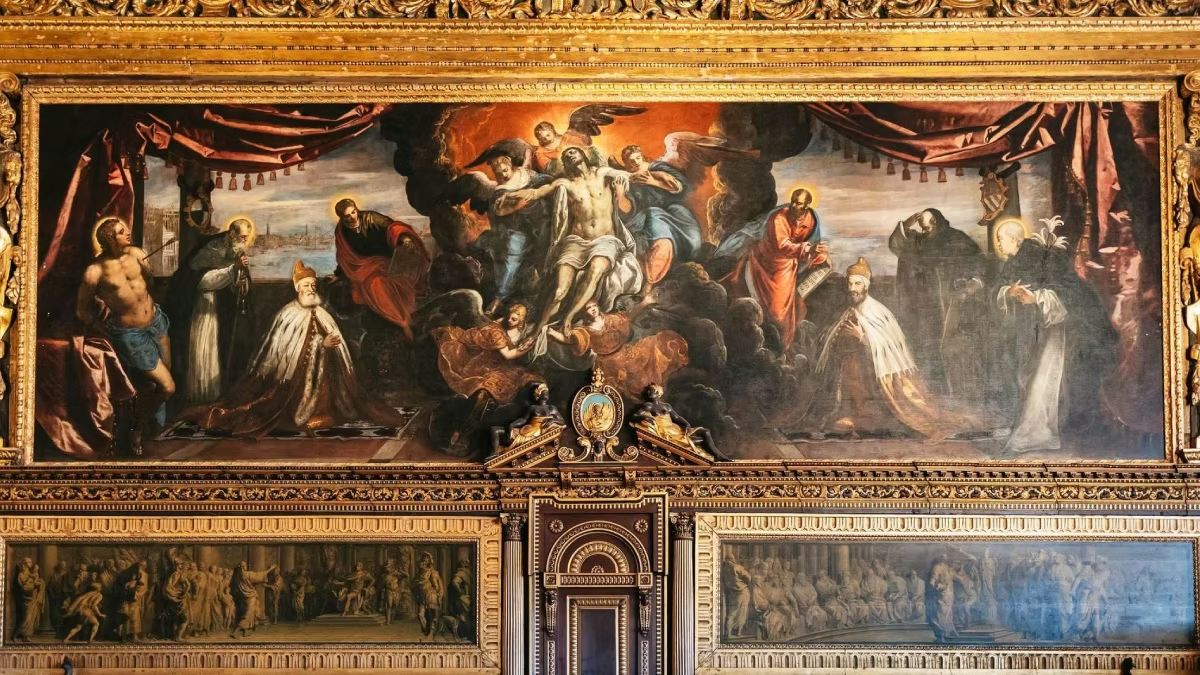
The Doge’s Palace holds one of the densest concentrations of Venetian Renaissance and Mannerist art anywhere. The essential artworks to prioritize are: (1) Tintoretto’s Paradise in the Chamber of the Great Council — the largest oil painting on canvas in the world at its creation; (2) Veronese’s Triumph of Faith ceiling in the Sala del Collegio — Veronese’s masterpiece in the palace; (3) Tintoretto’s Triumph of Venice ceiling in the Sala del Senato; (4) Sansovino’s statues of Mars and Neptune in the courtyard; (5) Titian’s portrait of Doge Antonio Grimani; (6) Carpaccio’s Lion of St. Mark; and several others. This article ranks the top 12 artworks with location, historical context, and viewing advice.
With roughly 30 rooms filled with art from multiple centuries by many of the Venetian Renaissance’s major masters, the Doge’s Palace can overwhelm visitors who want to prioritize what matters most. This article ranks the 12 most important artworks — giving each its historical context, location in the visitor route, and practical advice for seeing it well. Use this as your hit-list for a focused art-centered visit.
Quick-Reference Ranking
The 12 most important artworks in approximate order of historical significance and must-see priority. Ranking is subjective — art history credentials matter, but so does visibility and impact on a typical visit. The top 5 are essentially non-negotiable for any art-focused visit; items 6–12 reward a longer, slower visit.
| Rank | Work | Artist | Location | Date |
|---|---|---|---|---|
| 1 | Paradise | Tintoretto | Chamber of the Great Council | 1588–1592 |
| 2 | Triumph of Faith ceiling | Veronese | Sala del Collegio | 1575–1578 |
| 3 | Apotheosis of Venice | Veronese | Chamber of the Great Council (ceiling) | 1582 |
| 4 | Mars and Neptune statues | Sansovino | Giants’ Staircase, courtyard | 1554–1567 |
| 5 | Triumph of Venice | Tintoretto (workshop) | Sala del Senato ceiling | 1587–1594 |
| 6 | Portrait of Doge Antonio Grimani | Titian | Doge’s Apartments (Sala Grimani) | 1521–1523 |
| 7 | Lion of St. Mark | Carpaccio | Doge’s Apartments (Sala Grimani) | c. 1516 |
| 8 | Rape of Europa | Veronese | Sala dell’Anticollegio | 1580 |
| 9 | Votive Portrait of Doge Sebastiano Venier | Veronese | Sala del Collegio (wall) | 1581–1582 |
| 10 | Scala d’Oro gold-leaf stucco | Alessandro Vittoria | Golden Staircase vault | 1555–1559 |
| 11 | Bacchus and Ariadne | Tintoretto | Sala dell’Anticollegio | 1578 |
| 12 | Allegory of Victory over the League of Cambrai | Palma il Giovane | Sala del Senato | c. 1590 |
1. Tintoretto — Paradise (1588–1592)
Location: Chamber of the Great Council, back wall above the Doge’s throne position
The largest oil painting on canvas in the world at its creation, measuring approximately 22m × 9m. Contains around 500 individual figures arranged in concentric circles of light radiating from Christ and the Virgin Mary at the center.
Why it matters:
- Defining work of Tintoretto’s late career (painted when he was around 70)
- Executed with significant contributions from his son Domenico and the family workshop
- Replaced a 1365 Guariento fresco destroyed in the 1577 fire
- Designed with the Doge’s throne position as the geometric ideal viewing point
Viewing advice: See from multiple distances — far end of the room first for the overall composition, then gradually closer for detail. Allow at least 10 minutes for proper viewing.
Full dedicated guide: Chamber of the Great Council: Complete Guide.
2. Veronese — Triumph of Faith Ceiling (1575–1578)
Location: Sala del Collegio ceiling
Considered Veronese’s masterpiece in the Doge’s Palace. The central panel depicts Triumph of Faith, surrounded by four T-shaped allegorical panels: Simplicity, Dialectic, Vigilance, and Docility. The program celebrates the Good Government of the Republic, with Faith as its theological foundation and the Virtues as supporting pillars.
Why it matters:
- Commissioned after the 1574 fire destroyed earlier decoration
- Veronese’s most coherent ceiling program in the palace
- The gilded wooden framing by Francesco Bello and Andrea da Faenza integrates with the paintings as a total design
- Andrea Palladio designed the overall room layout
Viewing advice: Look up from multiple positions in the Sala del Collegio. The room has benches that allow comfortable ceiling viewing without neck strain.
Full dedicated guide: Veronese’s Ceilings: Complete Guide.
3. Veronese — Apotheosis of Venice (1582)
Location: Chamber of the Great Council, central ceiling oval
Veronese’s magnificent allegorical ceiling centerpiece in the palace’s largest room. Venice personified as a crowned female figure ascends in glory, being crowned by Victory. Below the ascending figure, a balcony filled with Venetian nobility and ordinary citizens looks up — a clever device linking the ceiling’s imagery with the room’s actual inhabitants.
Why it matters:
- Paired with Tintoretto’s Paradise on the wall beneath
- One of Veronese’s most important public commissions
- Technical tour-de-force in ceiling illusionism
- Political statement asserting Venetian civic virtues
Viewing advice: After studying Paradise at the end wall, turn and look up. The central oval is the primary work; smaller panels frame it. Plan 5–7 minutes of ceiling viewing in this room alone.
4. Sansovino — Mars and Neptune (1554–1567)
Location: Top of the Giants’ Staircase (Scala dei Giganti), courtyard
Two colossal statues flanking the top of the ceremonial staircase in the palace courtyard. Mars represents Venice’s land power (military); Neptune represents maritime power — the defining dual basis of the Venetian state.
Why it matters:
- Jacopo Sansovino’s most visible public sculpture in Venice
- Symbolic heart of the palace’s civic iconography
- Historical site of the Doge’s coronation ceremonies (kings and doges were crowned at the top of this staircase)
- Free to see: courtyard is accessible without palace admission (partial view)
Viewing advice: These are outdoor sculptures — you see them before entering the palace proper and again on the way out. Morning light is best for photography. The statues are at a height that requires stepping back for good viewing.
5. Tintoretto — Triumph of Venice (1587–1594)
Location: Sala del Senato ceiling, central panel
Also known as “Venice Receiving the Gifts of the Sea” — Tintoretto’s programmatic centerpiece in the Senate Hall. Venice personified as an enthroned female figure receives tribute from Neptune and maritime gods.
Why it matters:
- Largely executed by Domenico Tintoretto and the workshop
- Direct visual parallel to the Paradise in the Chamber of the Great Council: both assert Venetian divine/cosmic status
- Completed as part of the post-1574 fire reconstruction program
- Programmatically tied to the Sala del Collegio’s Veronese ceiling nearby
Viewing advice: Smaller room than the Chamber of the Great Council, so the ceiling is closer and easier to view. Look up for 3–5 minutes.
Full dedicated guide: Hall of the Senate: Complete Guide.
6. Titian — Portrait of Doge Antonio Grimani (1521–1523)
Location: Doge’s Apartments, Sala Grimani
One of Titian’s important ducal portraits, showing Grimani in full ducal regalia — the corno (pointed ducal cap), ermine-trimmed robes, and gold decorations.
Why it matters:
- Early Titian work, transitional between Bellini’s stiff formal portraits and Titian’s later psychologically intense portraits
- Doge Grimani’s actual likeness during his brief 1521–1523 reign
- Example of Titian’s emerging style that would transform European portraiture
Viewing advice: Get reasonably close — Titian’s brushwork rewards detailed viewing. The painting is behind protective glass, which creates reflection challenges.
Full dedicated guide: Doge’s Apartments: Complete Guide.
7. Carpaccio — Lion of St. Mark (c. 1516)
Location: Doge’s Apartments, Sala Grimani
The winged lion of Venice — the Republic’s symbol and patron saint’s attribute — depicted against a recognizable backdrop of St. Mark’s Square and the Venice lagoon. The lion holds an open book with the Venetian motto “Pax tibi Marce, Evangelista meus” (Peace to you, Mark, my Evangelist).
Why it matters:
- Major Carpaccio work in its original ducal-residence setting
- The open book is significant iconography: signifies Venice at peace: (a closed book would signify war)
- Major statement of Venetian civic identity
- Shows Carpaccio’s distinctive style (meticulous detail, local landscape backgrounds)
Viewing advice: Study the lion’s pose, the book’s wording, and the background landscape separately. Each element carries iconographic meaning.
8. Veronese — Rape of Europa (1580)
Location: Sala dell’Anticollegio (Antechamber to the Collegio)
Veronese’s dramatic mythological painting depicting Jupiter disguised as a bull carrying away Europa — a classical allegory often associated with Venice’s Mediterranean maritime ambitions (Venice as a carrier of cultural wealth between continents).
Why it matters:
- Considered one of the palace’s finest: Veronese works
- Dramatic coloristic composition typical of Veronese’s mature style
- Political reading: the myth parallels Venice’s Mediterranean reach
Viewing advice: The Sala dell’Anticollegio is small, so the painting is close. Compare with the Tintoretto wall paintings in the same room for stylistic contrast between the two rival Venetian masters.
9. Veronese — Votive Portrait of Doge Sebastiano Venier (1581–1582)
Location: Sala del Collegio, above the tribune (where the Doge sat)
Dramatic painting of Doge Sebastiano Venier (c. 1496–1578) kneeling and giving thanks to Christ for the Venetian victory at the Battle of Lepanto in 1571. Venier was the Venetian commander at Lepanto and later elected Doge.
Why it matters:
- Direct visual connection between the palace and the Battle of Lepanto: Venice’s most celebrated victory
- Shows how Veronese integrated contemporary history into devotional iconography
- Located where the actual Doge sat during Collegio meetings: visual reinforcement of ducal identity
Viewing advice: Position yourself facing the tribune (where the painting hangs above where the Doge sat). The painting’s angles are designed for that specific viewpoint.
10. Alessandro Vittoria — Scala d’Oro Stucco Vault (1555–1559)
Location: Golden Staircase ceiling
Not a single artwork but an integrated gold-leaf stucco decorative program covering the vaulted ceiling of the ceremonial staircase. Executed by Vittoria (Sansovino’s pupil) and collaborators.
Why it matters:
- Largest and most elaborate stucco program in the palace
- Gives the Scala d’Oro its name (“Golden Staircase”)
- Integrated iconographic program celebrating Venice
- First major commission of Alessandro Vittoria, who became one of Venice’s major late-16th-century sculptors
Viewing advice: Stop halfway up the staircase for the best overall view of the vault. Look for individual figurative panels within the larger decorative scheme.
Full dedicated guide: Golden Staircase (Scala d’Oro): Complete Guide.
11. Tintoretto — Bacchus and Ariadne (1578)
Location: Sala dell’Anticollegio
One of four Tintoretto mythological paintings originally made for the Atrio Quadrato, moved to the Sala dell’Anticollegio in 1716. Depicts Bacchus discovering Ariadne with rich classical symbolism — often read as an allegory of Venetian-Mediterranean union.
Why it matters:
- Considered one of Tintoretto’s best mythological paintings
- Typical of his dramatic lighting and bold composition
- Together with “Mercury and the Three Graces,” “Forge of Vulcan,” and “Minerva Expelling Mars” (also in this room), forms a coherent mythological-allegorical cycle
Viewing advice: Spend time in the Sala dell’Anticollegio despite its small size — the four Tintorettos plus Veronese’s Rape of Europa make this one of the most artistically dense rooms in the palace.
12. Palma il Giovane — Allegory of Victory over the League of Cambrai (c. 1590)
Location: Sala del Senato wall
Commemorates Venice’s survival of the War of the League of Cambrai (1508–1516), when a coalition of European powers combined to destroy the Republic. Doge Leonardo Loredan is the central figure — the same Doge whose famous portrait by Giovanni Bellini (now in London’s National Gallery) is one of the iconic Venetian Renaissance images.
Why it matters:
- Historically significant for Venetian self-narrative
- Example of late Venetian Mannerist painting by Palma il Giovane, the successor to Tintoretto
- Theological framing of political history: survival as divine miracle
Viewing advice: Study alongside the other Senate Hall wall paintings for the coherent political-theological program.
Artists Beyond the Top 12
The palace also contains works by:
- Jacopo Palma il Giovane: (1548–1628): successor to Tintoretto, numerous wall and ceiling works
- Domenico Tintoretto: (1560–1635): son of Jacopo Tintoretto, major contributor to late 16th-century programs
- Andrea Palladio: (1508–1580): architectural design (Sala delle Quattro Porte, Sala del Collegio layout)
- Pietro and Tullio Lombardo: sculptural relief work in the Doge’s Apartments
- Marco Vecellio: (1545–1611): nephew of Titian, wall paintings in the Sala del Senato
- Francesco Bassano: originally in competition for the Chamber of the Great Council Paradise commission
- Jacopo Sansovino: (1486–1570): architecture and sculpture throughout
- Hieronymus Bosch: several pieces in the Doge’s Apartments (lesser-known works)
Art-Focused Visit Strategy
An art-focused visit to the Doge’s Palace benefits from working through the standard visitor route but allocating time strategically. Budget roughly: 5 minutes for Sansovino’s statues in the courtyard, 10 minutes on the Scala d’Oro, 30–45 minutes in the Doge’s Apartments (especially Sala Grimani for Titian and Carpaccio), 15–20 minutes each in the Sala dell’Anticollegio and Sala del Collegio, 15 minutes in the Sala del Senato, and 25–35 minutes in the Chamber of the Great Council for Paradise and the ceiling. Total: 2.5–3.5 hours minimum.
Suggested art-focused sequence:
- Entrance + Courtyard: (15 min): Sansovino’s statues; the Porta della Carta carved façade
- Museo dell’Opera: (10 min): original capitals including the famous “Capital of the Vices”
- Scala d’Oro: (10 min): stucco vault by Vittoria
- Doge’s Apartments: (40 min): Titian’s Grimani portrait, Carpaccio’s Lion of St. Mark, Mercator maps
- Sala delle Quattro Porte: (5 min): Tintoretto ceiling
- Sala dell’Anticollegio: (20 min): four Tintorettos + Veronese’s Rape of Europa
- Sala del Collegio: (20 min): Veronese’s masterpiece ceiling + Votive Portrait of Venier
- Sala del Senato: (20 min): Tintoretto ceiling + Palma il Giovane wall paintings
- Sala del Consiglio dei Dieci: (10 min): Veronese ceiling (some replaced by Napoleon-era copies)
- Armoury: (10 min: skippable for art focus)
- Chamber of the Great Council: (30 min): Tintoretto’s Paradise + Veronese’s ceiling + Doge portraits
- Bridge of Sighs + Prisons: (15 min)
Total: approximately 3–3.5 hours for a thorough art-focused visit.
How to Look at These Works
General Principles
- Multiple distances: large paintings like Paradise read differently from 20 metres vs 2 metres
- Lighting changes: morning vs afternoon light illuminates different parts of rooms
- Benches in major rooms: use them for extended ceiling viewing
- Work through guided commentary: (MUVE app or printed guide) for iconographic context: Venetian paintings are dense with symbolic meaning that doesn’t read without context
Photography Realities
- No flash: throughout the palace
- Reflections through glass: many portraits are behind protective glass; shoot at angles
- Ceiling challenges: wide-angle lenses help; phone cameras struggle with dim ceiling coverage
- Wall painting challenges: raking light sometimes creates glare; step to different positions
Frequently Asked Questions
Which is the single most important artwork?
Tintoretto’s Paradise in the Chamber of the Great Council. Historically the largest oil painting on canvas in the world, politically significant as the backdrop of the ducal throne, artistically the crowning work of Tintoretto’s late career.
Which room has the most important art?
The Chamber of the Great Council for pure headline value (Paradise + Veronese’s Apotheosis ceiling). The Sala del Collegio for the coherent Veronese ceiling program. The Sala dell’Anticollegio for density of important works in a small space.
What’s the oldest artwork in the palace?
Guariento di Arpo’s 1365 fresco fragments — originally in the Chamber of the Great Council, partially preserved behind Tintoretto’s Paradise, now displayed separately in the Sala dell’Armamento. Most other artworks date from the 16th–17th centuries.
What’s not in the palace anymore?
Several works removed by Napoleon are now in the Louvre: Veronese’s “Jupiter Fulminating the Vices” (from the Sala del Consiglio dei Dieci ceiling) — replaced in the palace by a copy; and Veronese’s “Wedding at Cana” — the largest painting in the Louvre, originally from the Monastery of San Giorgio Maggiore (not the palace, but often mentioned).
Is photography allowed?
Yes without flash. Many works are behind glass, creating reflection challenges. No tripods or selfie sticks. See Dress Code, Bag Policy & Visitor Rules.
Which Tintoretto works are original vs workshop?
Paradise is substantially workshop-executed with Tintoretto supervision — his son Domenico and others did much of the physical painting. Some Sala del Senato wall paintings are workshop works. The Sala dell’Anticollegio mythologies are considered largely autograph Tintoretto.
Which Veronese works are autograph?
The Sala del Collegio ceiling (1575–1578) is largely autograph and one of Veronese’s best-preserved major works. The Rape of Europa is autograph. The Apotheosis of Venice ceiling in the Chamber of the Great Council involved substantial workshop assistance.
Are there any female artists represented?
Not meaningfully on the standard visitor route. The major works are all by male artists — typical of Renaissance-era commissioned religious and civic art.
Can I buy reproductions of the key works?
The palace bookshop stocks reproductions and high-quality art books. Print-on-demand reproductions of major palace works are widely available online.
How do I identify the specific panels on a ceiling?
Most ceiling panels are labelled on informational placards in each room. The MUVE app audio guide identifies individual works. Guided tours specifically name-check the important pieces.
