

Doge's Palace Rooms Guide 2026: Every Major Room Explained
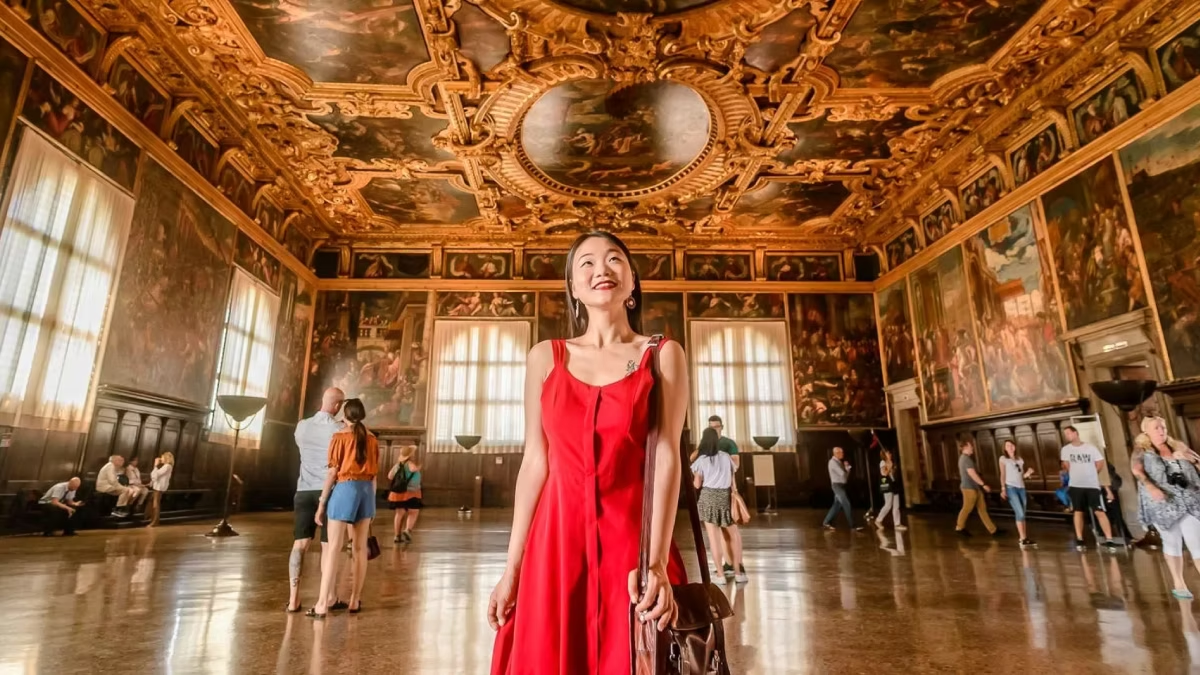
The Doge’s Palace contains roughly 30 significant rooms spread across four floors, grouped into distinct functional areas: the Doge’s Apartments (first floor, the residential rooms), the institutional rooms (second floor, where government actually happened — Collegio, Senate, Council of Ten), the Chamber of the Great Council (the climactic main hall with Tintoretto’s Paradise), the Armoury (four rooms of weapons), and the Bridge of Sighs + New Prisons (the dramatic conclusion). The Secret Itineraries and Hidden Treasures tours access additional rooms not on the standard visitor route. This pillar guide covers every major room in visit order.
Walking through the Doge’s Palace without understanding what each room actually did — as a functioning piece of Venetian government — is like walking through a medieval cathedral without knowing which parts were for the priests and which for the worshippers. This article is the hub for the What to See category: a room-by-room overview linking to detailed guides for each major space. Use it as your navigation map.
The Four Functional Zones
The palace’s rooms divide into four logical zones. Residential (the Doge’s Apartments on the first floor, where the elected ruler actually lived) occupies roughly 20% of the building. Institutional (Collegio, Senate, Council of Ten, Great Council) occupies the largest share, reflecting that Venice was a republic, not an absolute monarchy. Military (the Armoury) takes up four connected rooms. Judicial (Bridge of Sighs + New Prisons) connects across the canal. The Secret Itineraries rooms are administrative/penal spaces hidden from the standard route.
| Zone | Primary Rooms | Typical Visit Time |
|---|---|---|
| Residential | Doge's Apartments (8 rooms on first floor) | 20-30 min |
| Institutional | Quattro Porte, Anticollegio, Collegio, Senato, Consiglio dei Dieci, Bussola | 30-45 min |
| Ceremonial | Chamber of the Great Council, Sala dello Scrutinio | 20-30 min |
| Military | Armoury (4 rooms) | 15-25 min |
| Judicial | Bridge of Sighs, New Prisons | 15-20 min |
| Reception | Scala d'Oro, courtyard, Museo dell'Opera | 15-20 min |
The Courtyard and the Giants’ Staircase
The first space visitors encounter inside the palace is the open-air courtyard (Cortile), dominated by the Scala dei Giganti (Giants’ Staircase). Two massive statues of Mars and Neptune by Jacopo Sansovino (1554-1567) flank the top of the staircase, symbolizing Venice’s military and maritime power. Historic doges were crowned at the top of this staircase in public ceremonies.
- Built: 1490-1491 by Antonio Rizzo (staircase); Sansovino statues added later
- Function:: Ceremonial entrance, crowning of the Doge
- What to look for: The bronze well-heads (vere da pozzo) in the courtyard, and the detailed reliefs on the Arco Foscari (entrance arch)
Photography is best here in morning light when the statues are fully illuminated.
The Museo dell’Opera (Ground Floor)
A small museum at the start of the visitor route, displaying original sculptural capitals from the palace’s exterior columns. The capitals you see on the façade today are replicas — the originals are here, protected from weathering.
- Function:: Preservation of original 14th-15th century stone carvings
- What to look for: Capital #18 (the “Capital of the Vices” with medieval moralistic sculptures) is the most famous
- Visit time: 10-15 minutes
The Scala d’Oro (Golden Staircase)
The ornate staircase leading from the ground floor to the first floor. Originally designed by Sansovino (1554), finished by Scarpagnino. Called “Golden” for the gold-leaf stucco decorations covering the vaulted ceiling.
- Function:: Ceremonial access to the Doge’s Apartments and upper state rooms
- What to look for: The white-and-gold ceiling program, the elaborate stucco reliefs
- Visit time: 5-10 minutes including photography
See the dedicated guide: Golden Staircase (Scala d'Oro): Complete Guide.
The Doge’s Apartments (First Floor)
The Doge lived in these eight rooms during his term (which was for life, though some served brief periods). The apartments are smaller-scale and more intimate than the institutional rooms, featuring personal portraits, family decoration, and the world map room (Sala del Scudo) that shows how 16th-century Venetians understood world geography. Paintings by Titian, Vittore Carpaccio, and Hieronymus Bosch are among the notable works in this zone.
The eight apartment rooms
- Sala degli Scarlatti: (Scarlet Hall): red-walled audience chamber
- Sala dello Scudo (Shield Hall): walls covered in massive Mercator world maps
- Sala Grimani: with Carpaccio’s “Lion of St. Mark”
- Sala Erizzo
- Sala degli Stucchi: elaborate stucco decorations
- Sala dei Filosofi (Philosophers’ Hall)
- Sala delle Corazze (Armour Hall)
- Sala dei Ritratti (Portraits Hall)
Notable highlights
- The Mercator world maps: in the Sala dello Scudo: early cartographic representation showing 16th-century Venetian geographic understanding
- Carpaccio’s “Lion of St. Mark” in the Sala Grimani: showing the winged lion holding an open book (signifying Venice at peace)
- Family portraits reflecting the individual doges who lived in each room
Full guide: Doge's Apartments: What to See.
The Institutional Rooms (Second Floor)
This zone is the political heart of the palace — where Venice’s government actually functioned. Unlike most European royal palaces, where power concentrated in one ruler’s chamber, Venice’s republic distributed power across multiple rooms housing different councils.
Sala delle Quattro Porte (Four Doors Hall)
The antechamber to the main state rooms. Ceiling designed by Tintoretto (1577-1578). The four marble doorways give the room its name, each leading to a different institutional function.
Sala dell’Anticollegio
Waiting room for ambassadors before being received by the Doge. Paintings by Tintoretto (The Forge of Vulcan, Mercury and the Three Graces, Pallas Expelling Mars, Bacchus and Ariadne) and Veronese (Rape of Europa).
Sala del Collegio
Where the Doge and senior ministers received foreign ambassadors. The ceiling is Veronese’s most important program in the palace — paintings celebrating Venetian virtues (Faith, Justice, Mars and Neptune).
- Ceiling painter:: Paolo Veronese
- Wall paintings: Tintoretto
- Function: Diplomatic reception
Sala del Senato (Senate Hall)
Meeting chamber of the Venetian Senate (approximately 120 members, drawn from the senior nobility). Ceiling by Tintoretto featuring “The Triumph of Venice.”
- Capacity: 120 senators plus administrative staff
- Function:: Foreign policy, treasury, war declaration
- Key artwork: Tintoretto’s “Triumph of Venice” ceiling centerpiece
Full guide: Hall of the Senate: Complete Guide.
Sala del Consiglio dei Dieci (Council of Ten)
Meeting room of Venice’s powerful secretive security council — the committee that handled state security, intelligence, and prosecution of nobles accused of political crimes. Despite its name, the Council of Ten operated with up to 17 members (the Doge, his six advisors, and the ten elected members).
- Function:: Intelligence and prosecution of political crimes
- Ceiling: Veronese
- Symbolic role: The Council of Ten was feared throughout Venice for its wide-ranging and secretive authority
Sala della Bussola (Compass Room)
The antechamber to the Council of Ten’s chamber, named for the compass-shaped wooden cabinet (bussola). This room contains the famous bocche di leone — the “lion’s-mouth” slots in the walls where citizens could drop anonymous denunciations against other Venetians.
- Function:: Filing room for denunciations; waiting room
- Key feature: The surviving bocca di leone denunciation slots
- Historical significance: Venetian surveillance state
The Armoury (Armeria) — Four Connected Rooms
Original armoury and weapons collection of the Venetian Republic. Contains roughly 2,000 historical weapons, armor, crossbows, cannons, and military artifacts spanning the 14th-17th centuries.
- Highlights:: Henry IV’s armor (gift to Venice), captured Turkish weapons from the Battle of Lepanto (1571), ceremonial ducal armor
- Visit time: 15-25 minutes
- Appeal: One of the most popular sections for families with children
Full guide: Armoury (Armeria): Complete Guide.
Sala dello Scrutinio (Ballot Hall)
The vote-counting hall where Venetian nobles’ ballots for magistrates, senators, and the Doge himself were tallied. Ceiling program celebrates Venetian military victories. Contains the “Last Judgment” painting by Palma il Giovane.
- Function:: Election tabulation
- Ceiling: Palma il Giovane and workshop
- Historical role: Where Venice’s sophisticated electoral mathematics was performed
The Chamber of the Great Council (Sala del Maggior Consiglio)
The palace’s single most famous room — the largest single room in Europe without internal supports (53m × 25m). This was where the Maggior Consiglio (up to 2,000 members of the Venetian nobility) met to legislate and elect magistrates. Tintoretto’s massive Paradise (22m × 9m, completed 1588-1592) covers the back wall above the Doge’s throne — historically the largest oil painting in the world. 76 doge portraits ring the upper walls, including the famous black curtain covering the portrait of Marin Falier (doge executed for treason in 1355).
- Dimensions: 53m × 25m (174ft × 82ft)
- Capacity: 1,200-2,000 noblemen
- Function:: Legislation and electoral voting
- Key artwork: Tintoretto’s “Paradise” (wall behind Doge’s throne), painted 1588-1592
- Ceiling: Veronese, Tintoretto, Palma il Giovane
- Visit time: 15-25 minutes
This is the room most visitors associate with the palace. Deserves more time than most visitors give it.
Full guide: Chamber of the Great Council: Complete Guide.
The Bridge of Sighs and New Prisons
The Bridge of Sighs (Ponte dei Sospiri), completed in 1603 by Antonio Contin, is a short enclosed bridge connecting the Doge’s Palace to the New Prisons (Prigioni Nuove) across the Rio di Palazzo canal. Its name reflects the sighs of condemned prisoners seeing Venice for the last time through its small latticed windows. The New Prisons replaced the palace’s original damp basement cells (Pozzi or “wells”) for most prisoners, and housed inmates until the 1920s. The crossing and prison visit together take 15-20 minutes.
The bridge itself
- Completed: 1603
- Architect:: Antonio Contin
- Length: ~11 meters
- Material: White Istrian stone
- Style: Venetian Baroque
The New Prisons
- Period of use:: Early 17th century to 1920s
- Capacity: ~40 cells across multiple floors
- Notable prisoner: Giacomo Casanova (imprisoned 1755, escaped 1756: though from the Piombi cells in the palace attic, not the New Prisons)
- Visit highlights: Original cell architecture, prison graffiti, interrogation rooms
Full guide: Bridge of Sighs & New Prisons: Complete Guide.
The Secret Itineraries Rooms (Separate Tour Required)
Rooms not accessible on the standard visitor route, available only via the Secret Itineraries Tour (75 minutes, €40):
- Chancellery: where state secrets and official records were kept
- Torture Chamber: (Sala del Tormento): intact interrogation apparatus
- Piombi Cells: “lead cells” in the attic, named for the lead roof making them brutally hot in summer and cold in winter. Where Casanova was imprisoned.
This tour is strictly guided — no self-access. See Secret Itineraries Tour: Complete Guide.
The Hidden Treasures Rooms (Separate Tour Required)
A second special tour — the Doge’s Hidden Treasures Tour — accesses:
- Terrazza Foscara: entry terrace with 19th-century commemorative sculptures
- Loggia Foscara: Renaissance addition to the Gothic palace
- Sala dei Forzieri: the palace Treasury Chamber
- Chiesetta and Antichiesetta del Doge: the Doge’s private chapel and antechamber, restored with original decorative splendor
Standard Visit Route Summary
The standard one-way visitor route covers:
- Porta del Frumento (entrance)
- Courtyard and Scala dei Giganti
- Museo dell’Opera
- Scala d’Oro
- Doge’s Apartments (8 rooms)
- Sala delle Quattro Porte
- Sala dell’Anticollegio
- Sala del Collegio
- Sala del Senato
- Sala del Consiglio dei Dieci
- Sala della Bussola
- The Armoury (4 rooms)
- Sala dello Scrutinio
- Chamber of the Great Council
- Bridge of Sighs
- New Prisons
- Exit via courtyard
Total walking distance: approximately 1.5 km. Total standard visit time: 2-3 hours.
See How Long Does a Doge's Palace Visit Take for timing by visitor type and Doge's Palace Map & Floor Plan for building layout.
Priority Rooms If Time Is Limited
For visitors with only 90-120 minutes, the top 5 rooms to prioritize:
- Chamber of the Great Council: the headline room with Paradise
- Sala del Collegio: best Veronese ceiling in the palace
- Sala del Senato: best Tintoretto ceiling
- Scala d’Oro: the ornate ascent
- Bridge of Sighs: brief but memorable
If you can add one more: the Armoury for engagement or the Sala della Bussola for the denunciation slots.
Frequently Asked Questions
Which room is the most important?
The Chamber of the Great Council (Sala del Maggior Consiglio) — the largest room and home to Tintoretto’s Paradise.
Is the route one-way?
Yes, largely. You can’t easily backtrack to earlier rooms, so plan to spend the right amount of time in each before moving on.
How many rooms are on the standard tour?
Roughly 25 distinct rooms across the main route, plus the courtyard and the New Prisons across the bridge.
What rooms have the best paintings?
For Tintoretto: Chamber of the Great Council (Paradise), Sala del Senato ceiling, Sala dell’Anticollegio walls. For Veronese: Sala del Collegio ceiling, Sala del Consiglio dei Dieci. For Carpaccio: Sala Grimani (Doge’s Apartments). For Palma il Giovane: Sala dello Scrutinio.
Which rooms are the most popular with kids?
The Armoury, the Bridge of Sighs crossing, and the New Prisons. See Visiting Doge’s Palace with Kids.
Can I photograph all the rooms?
Yes, without flash. No tripods or selfie sticks. See Dress Code, Bag Policy & Visitor Rules.
How are the rooms numbered?
There isn’t a universal numbering system. Room names use historical Venetian naming (Sala del Collegio, Sala del Senato, etc.). Some guidebooks assign numbers to aid navigation but these are not official.
Are all rooms open every day?
Most are open during standard opening hours. Individual rooms may close temporarily for conservation work, but the main highlights are almost always accessible.
What’s the difference between the Great Council and the Senate?
The Great Council (Maggior Consiglio) was the broadest legislative body — up to 2,000 members of the nobility who met to approve laws and elect magistrates. The Senate was a smaller, more specialized body of 120 senior nobles focused on foreign policy, treasury, and war decisions.
What is the Council of Ten?
Venice’s powerful security council — elected nobles handling state security, intelligence, and prosecution of political crimes. Despite the name, it typically operated with 17 members (the ten elected plus the Doge and his six advisors).
