

Doge’s Palace Map & Floor Plan: Complete Building Guide
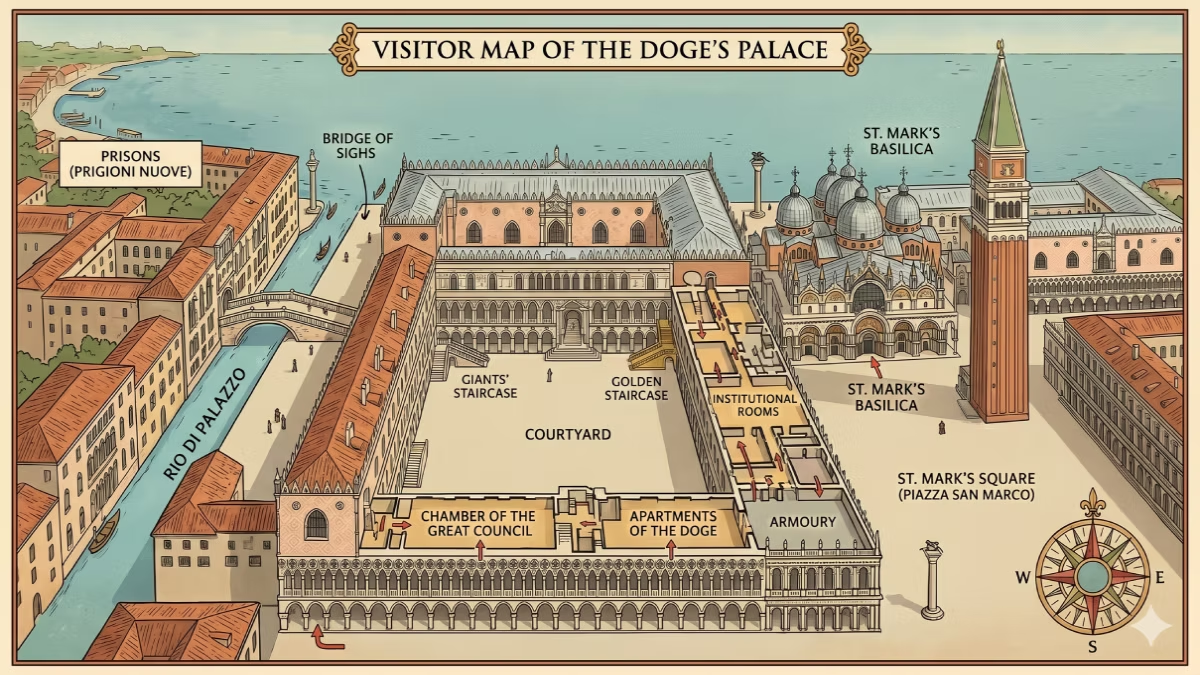
The Doge’s Palace is a four-storey Gothic building arranged around a central courtyard. The visitor route runs ground floor (courtyard, museum entrance) → first floor (Museo dell’Opera, Doge’s Apartments) → second floor (institutional rooms — Collegio, Senate, Council of Ten, Chamber of the Great Council, Armoury) → ground level (New Prisons via the Bridge of Sighs) → exit. Total route length is approximately 1.5 km of walking. The building covers roughly 10,000 square meters across all floors. Knowing the layout helps you plan which rooms to prioritize, especially when time is limited.
Navigating the Doge’s Palace without understanding its layout can feel like walking through rooms randomly. The palace is genuinely large (bigger than most visitors expect) and follows a specific one-way visitor flow that determines what you see when. This guide breaks down the building by floor, explains the standard visitor route, notes where the Secret Itineraries rooms sit within the structure, and flags the rooms most worth prioritizing if your time is limited.
Building Overview
The Doge’s Palace is a four-storey Gothic building (ground floor plus three upper floors) with a central courtyard. It connects to the New Prisons via the Bridge of Sighs. The building footprint is approximately 71m × 75m, rising about 35m tall. Total visitor floor area is approximately 10,000 square meters across all accessible floors.
The palace’s layout reflects its multiple historical functions:
- Residence of the Doge: (Venice’s elected ruler): concentrated in the Doge’s Apartments on the first floor
- Seat of Venetian government: the institutional rooms (Collegio, Senate, Council of Ten, Chamber of the Great Council) on the second floor
- Court and prison: original prisons on the ground floor (now closed for visitors); the New Prisons (17th century) across the canal via the Bridge of Sighs
- Ceremonial and reception spaces: the Scala d’Oro (Golden Staircase) and the ceremonial halls
Architecturally, the building is Venetian Gothic with distinctive pointed arches and quatrefoil windows. The famous pink-and-white diamond pattern on the façade is made of Istrian stone and Verona marble. The main façade faces the lagoon and the Piazzetta San Marco.
The Three Main Floors
Ground Floor
The entry level. Houses:
- Porta del Frumento: the main visitor entrance, on the Piazzetta (southwest corner)
- Central courtyard (Cortile): the open-air interior courtyard with the Scala dei Giganti (Giants’ Staircase) dominated by statues of Mars and Neptune
- Ticket office and cloakroom
- Restrooms
- Bookshop
- Original prisons: (the Pozzi: “wells”: the original damp cells in the palace base): partially accessible on the Secret Itineraries Tour only
- Loggia (outer arcade): the covered walkway around the courtyard
Time typically spent on the ground floor: 15–20 minutes including courtyard appreciation and the Scala d’Oro climb.
First Floor (Piano Nobile, Private Area)
Home to the Doge’s residential and ceremonial apartments. Includes:
- Museo dell’Opera: a small museum at the start of the visitor route, displaying original sculptural capitals from the palace’s exterior columns (replaced with replicas for preservation)
- Scala d’Oro (Golden Staircase): the ornate staircase leading to the upper ceremonial floors, covered in gold-leaf stucco and painted decorations
- Atrio Quadrato: the square vestibule that serves as the entrance to the Doge’s formal reception rooms
- Doge’s Apartments: (Appartamento del Doge): 8 rooms including:
- Sala degli Scarlatti (Scarlet Hall)
- Sala del Scudo (Shield Hall: with enormous wall maps of the world)
- Sala Grimani
- Sala Erizzo
- Sala degli Stucchi
- Sala dei Filosofi (Philosophers’ Hall)
- Sala del Corazze (Hall of Armour)
- Sala dei Ritratti (Portraits Hall)
Time typically spent on the first floor: 30–45 minutes.
The Doge’s Apartments feel more intimate than the institutional rooms above — smaller scale, more personal in decoration, with family portraits and smaller paintings. The Sala del Scudo has the Mercator world maps that show how Venetians understood 16th-century geography.
Second Floor (Piano Nobile, State Rooms)
The heart of the palace — where Venice’s government actually functioned. The largest and most famous rooms are here. Includes:
- Atrio Quadrato: landing from the Scala d’Oro
- Sala delle Quattro Porte (Four Doors Hall): the antechamber to the main state rooms, with a ceiling by Tintoretto
- Sala dell’Anticollegio: ante-room to the Collegio, with Tintoretto and Veronese paintings
- Sala del Collegio: where the Doge and senior ministers received foreign ambassadors. Ceiling program by Veronese.
- Sala del Senato (Senate Hall): where the Venetian Senate met. Ceiling by Tintoretto.
- Sala del Consiglio dei Dieci (Council of Ten Hall): meeting room of Venice’s powerful secretive security council
- Sala della Bussola: the “Compass Room,” location of the famous bocche di leone (lion’s-mouth) denunciation boxes
- Armoury (Armeria): four connected rooms displaying 2,000+ historical weapons, armor, and military artifacts
- Sala dello Scrutinio: the Ballot Hall, where scrutineers counted votes for state elections
- Sala del Maggior Consiglio (Chamber of the Great Council): the climax of the visit. The largest room in Europe without internal supports (54m × 25m). Home to Tintoretto’s massive Paradise painting (22m wide: the largest oil painting in the world at the time of its creation).
- Libreria: the palace library
Time typically spent on the second floor: 60–90 minutes.
This is where the bulk of the palace’s art and history lives. The Chamber of the Great Council alone deserves 15–25 minutes.
Third Floor and Prison Floors
- Mezzanine of the Chancellery: upper administrative offices (closed to general visitors; accessible on Secret Itineraries Tour)
- Piombi cells: the “lead” cells in the attic, named for the lead roof that made them brutally hot in summer and cold in winter. Famous prisoner: Giacomo Casanova (escaped in 1756). Accessible only on Secret Itineraries Tour.
The Standard Visitor Route
The visitor route is essentially one-way, starting at the Porta del Frumento entrance on the Piazzetta side, going through the courtyard, up the Scala d’Oro, through the first-floor Doge’s Apartments, up to the second-floor institutional rooms and Armoury, finishing at the Chamber of the Great Council. From there, the route crosses the Bridge of Sighs to the New Prisons, then loops back and exits via the ground-floor courtyard. The full route is approximately 1.5 km of walking.
Step-by-step flow:
- Enter at Porta del Frumento: (Piazzetta side, south entrance)
- Security screening and ticket scan
- Courtyard: appreciate the Scala dei Giganti (Giants’ Staircase) with Mars and Neptune statues
- Museo dell’Opera: small museum with original capital sculptures
- Scala d’Oro (Golden Staircase): ascend to the first floor
- Doge’s Apartments: 8 connected rooms, first floor
- Ascend to second floor via the inner route: (another short staircase)
- Sala delle Quattro Porte: landing for the institutional rooms
- Sala dell’Anticollegio → Sala del Collegio → Sala del Senato
- Sala del Consiglio dei Dieci → Sala della Bussola
- Armoury (Armeria): four connected rooms of weapons and armor
- Sala dello Scrutinio: (vote-counting hall)
- Sala del Maggior Consiglio (Chamber of the Great Council): the climactic room
- Descend to the Bridge of Sighs level
- Bridge of Sighs crossing: brief views through the latticed windows
- New Prisons: cells, corridors, and interrogation rooms
- Return via the bridge
- Exit: through ground-floor exit route
Expected distance walked: approximately 1.5 km including the loops in multi-room sections. This is genuinely more than most visitors expect.
The Chamber of the Great Council (Sala del Maggior Consiglio)
The single most important room in the palace deserves specific mention:
- Size: 54 meters long × 25 meters wide × 12 meters tall
- Use:: Met with 1,200–2,000 members of the Venetian nobility (the Maggior Consiglio) during the Republic
- Key artwork:: Tintoretto’s Paradise: 22m × 9m oil painting on canvas, covering the back wall above the Doge’s throne. When completed in 1594, it was the largest oil painting in the world.
- Other works:: Portraits of 76 doges ring the upper walls (with the famous black panel covering Marino Falier, executed for treason in 1355)
- Ceiling:: Painted panels by Veronese, Tintoretto, Palma il Giovane
Spend 15–25 minutes here if you can. The room is designed for political theatre and rewards slow appreciation.
The Bridge of Sighs and New Prisons
The Bridge of Sighs is a short enclosed bridge connecting the Doge’s Palace to the New Prisons across the Rio di Palazzo canal. It was built in 1600 and named for the sighs of condemned prisoners getting their final glimpse of Venice through its small latticed windows. The New Prisons (Prigioni Nuove) replaced the damp palace-basement cells and held prisoners from the late 16th century until the 1920s. The bridge crossing itself takes 5–10 minutes; the prison tour adds another 10–15 minutes.
Key rooms in the New Prisons:
- Gallery and cell blocks: original 17th-century prison architecture
- Exercise yard
- Interrogation rooms
- Individual cells: with original graffiti from inmates
This section is atmospheric rather than visually spectacular — austere stone, small windows, heavy doors. A well-earned contrast to the opulent state rooms above.
The famous external view of the Bridge of Sighs (from the Ponte della Paglia on the Riva degli Schiavoni) is visible without palace admission — it’s the iconic photography angle.
The Secret Itineraries Route
The Secret Itineraries Tour visits rooms that are not on the standard route. These include the Chancellery on the upper floor (where palace records were stored), the torture chamber (Sala del Tormento), and the Piombi cells in the attic (where Casanova was imprisoned). The tour is strictly guided — no self-access. Runs 75 minutes on a fixed schedule with 3–4 English departures per day. Book 2–6 weeks in advance during peak season.
The Secret Itineraries route adds layers not visible on the main visit:
- Administrative third floor: notary offices and record storage rooms never decorated for ceremonial purposes
- Chancellery (Cancelleria): where state secrets were kept
- Torture chamber (Sala del Tormento): intact interrogation apparatus
- Piombi cells: attic-level cells with original prisoner graffiti, including Casanova’s escape route
- Specific passage routes: through the building not shown on the public floor plan
See Secret Itineraries Tour: Complete Guide for booking and tour details.
Priority Rooms If Time Is Limited
If you have less than 90 minutes at the palace, prioritize:
| Priority | Room | Why |
|---|---|---|
| 1 | Chamber of the Great Council | Largest room, Tintoretto’s Paradise |
| 2 | Sala del Collegio | Best Veronese ceiling |
| 3 | Sala del Senato | Best Tintoretto ceiling |
| 4 | Scala d’Oro | Photogenic ascent |
| 5 | Courtyard with Giants’ Staircase | Architectural highlight |
| 6 | Bridge of Sighs | Brief but memorable |
| 7 | Doge’s Apartments (Sala del Scudo especially) | Historical world maps |
| 8 | Armoury | Skippable for non-enthusiasts |
| 9 | New Prisons | Atmospheric but brief |
| 10 | Anticollegio | Transition space with art |
If you have exactly 60 minutes: focus on the courtyard, Chamber of the Great Council, Collegio, Senato, and Bridge of Sighs. Accept that you’ll skim the Doge’s Apartments and skip the Armoury.
For a detailed prioritization of what’s worth seeing: Top Doge’s Palace Artworks Guide.
Physical Layout Notes
Some layout details that matter in practice:
- Bathrooms are scattered: at multiple points along the route: you don’t need to hold it for hours
- The Scala d’Oro is steep: and has uneven steps; handrails present
- The route is largely one-way: you can’t easily backtrack without leaving the main visitor flow
- Elevators are available: for accessibility but access is via staff escort
- Photography is permitted: throughout the palace (no flash)
- Food and drinks are not permitted: in the palace (including water bottles in some rooms)
- Large bags must be checked: at the cloakroom before entry
- Seating is limited: benches exist in some rooms but not all; be prepared to stand for extended periods
Getting Lost: Common Navigation Issues
The palace has a few places where visitors commonly get confused:
- The transition from first to second floor.: The inner staircase up from the Doge’s Apartments isn’t obvious: follow the arrow signs or staff direction.
- The Armoury exit.: The four rooms connect in a loop; the exit is back through the entrance room, not further in.
- The Bridge of Sighs direction.: You cross twice: once outbound to the prisons, once back to exit. Staff usually direct traffic.
- The final exit route.: After returning from the prisons, you descend back to the courtyard via a different staircase than you came up on. Don’t try to retrace your original path.
If you get genuinely lost, staff are present in every major room and can redirect.
Accessibility Within the Floor Plan
Most rooms are accessible via elevators with staff assistance. The main visitor route has elevator access to the first and second floors. The Bridge of Sighs and New Prisons are accessible via stairs only — wheelchair users cannot access these sections. Alternative viewing areas exist.
Accessible vs non-accessible sections:
| Section | Wheelchair Accessible? |
|---|---|
| Courtyard | Yes |
| Doge’s Apartments (first floor) | Yes (via elevator) |
| Institutional rooms (second floor) | Yes (via elevator) |
| Chamber of the Great Council | Yes |
| Armoury | Yes |
| Bridge of Sighs | No (stairs) |
| New Prisons | No (stairs + narrow corridors) |
| Piombi cells / attic | No (Secret Itineraries only, stairs) |
Visitors using wheelchairs can still access ~80% of the standard visitor experience. See Doge’s Palace Accessibility Guide for full details.
Frequently Asked Questions
How large is the Doge’s Palace?
The building is approximately 71m × 75m in footprint, rising 35m tall, with approximately 10,000 square meters of visitor floor area across all accessible floors.
Is there a map available inside the palace?
Paper maps are available at the ticket office and information desks. Audio guides include interactive maps on the device screen.
How long does it take to walk the complete visitor route?
The full route is about 1.5 km. Without stopping, you could walk it in 25–30 minutes. Realistically, with viewing time in each room, plan 2–3 hours.
Can I revisit rooms I’ve already passed?
The route is largely one-way, but you can backtrack within specific sections (e.g., going back through a room in the Armoury). Full backtracking to re-visit the Doge’s Apartments after reaching the Chamber of the Great Council isn’t practical.
Is the courtyard free to enter without a ticket?
Yes, for a small portion of the courtyard accessible from the Porta della Carta (the ceremonial entrance on the St. Mark’s Square side). Full courtyard access requires a ticket.
What’s the single most impressive room?
The Chamber of the Great Council (Sala del Maggior Consiglio). Largest single room, Tintoretto’s Paradise, 76 doge portraits — this is the climactic room.
Which rooms have the best Veronese works?
The Sala del Collegio ceiling has Veronese’s best-known ceiling program in the palace.
Which rooms have the best Tintoretto works?
The Sala del Senato ceiling and, of course, the Paradise in the Chamber of the Great Council.
Is the Bridge of Sighs as dramatic inside as outside?
Less dramatic inside. The external view (from Ponte della Paglia) shows the bridge’s famous silhouette; inside it’s a short enclosed corridor with small latticed windows.
Can I see the palace from the outside without paying?
Yes. The entire exterior — including the Porta della Carta, the lagoon façade, the Ponte della Paglia view of the Bridge of Sighs — is freely visible. Only interior access requires a ticket.
Where are the restrooms?
Multiple restrooms along the visitor route on both the first and second floors. The ground floor also has restrooms near the ticket office and exit.
Are there benches to rest on inside the palace?
Limited seating. A few benches in larger rooms (Chamber of the Great Council has benches). Most rooms require standing. If you tire easily, plan a break outside mid-visit — your ticket remains valid for re-entry.
For more planning questions: Doge’s Palace FAQs.
