

Doge’s Apartments: Complete Guide to the First-Floor Residential Rooms
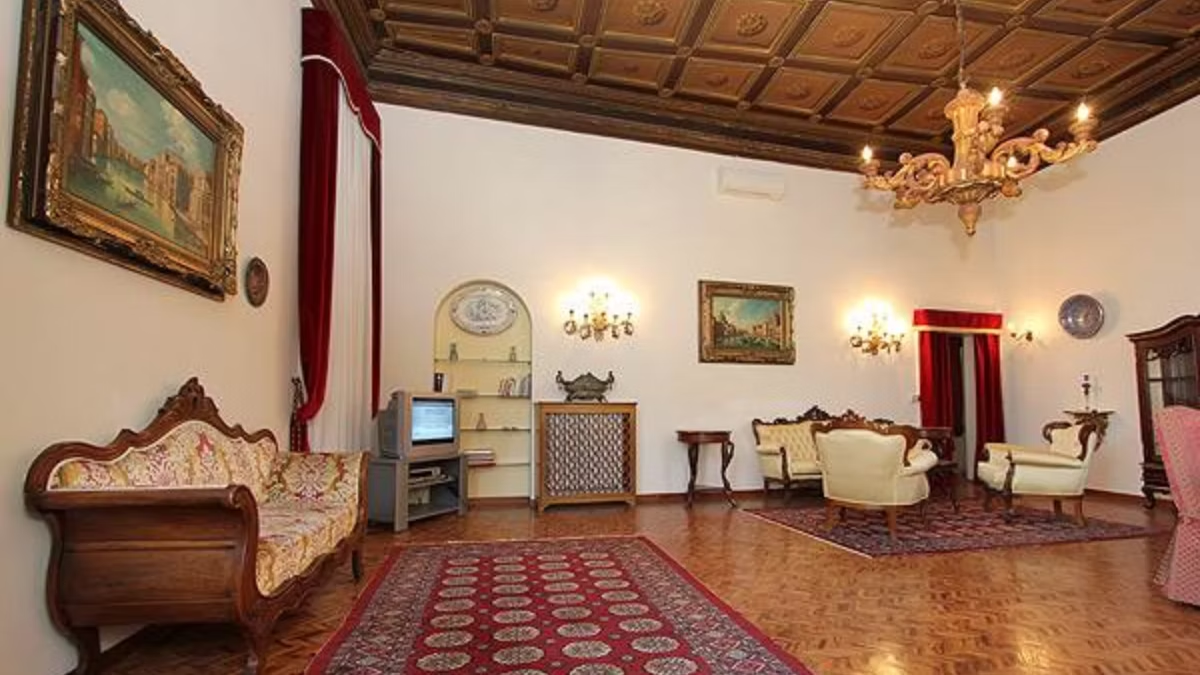
The Doge’s Apartments (Appartamento del Doge) are the eight residential rooms on the first floor of the Doge’s Palace where the elected Doge actually lived during his term in office. Unlike the grand state rooms above, these spaces are smaller, more intimate in scale, and more personal in decoration — portraits, family mementoes, and rooms that functioned like a working home. Key highlights include Titian’s portrait of Doge Antonio Grimani in the Sala delle Quattro Porte area, Carpaccio’s “Lion of St. Mark” in the Sala Grimani, and the remarkable Sala dello Scudo with massive wall-mounted Mercator world maps showing 16th-century Venetian geographic knowledge. Plan 25–35 minutes here on a standard visit.
The Doge’s Apartments are often underappreciated compared to the spectacular Chamber of the Great Council above them. That’s understandable — these rooms are smaller, the artworks less monumental, the spaces more domestic. But they offer something the state rooms don’t: a window into how a Venetian Doge actually lived, within the severe constraints the Republic placed on its elected ruler. The maps in the Sala dello Scudo alone are worth the visit. This guide covers each of the eight rooms, the key artworks, and the political context of how the Doge operated in this space.
How the Doge Actually Lived
The Doge was an elected ruler for life, chosen through an elaborate multi-stage process by the nobility. Despite the title, his actual power was severely constrained — he could not leave Venice without Council permission, could not conduct personal business with foreigners, could not own property outside Venice, and was surrounded by his six advisors (the Minor Council) at nearly all times. The apartments reflect this constrained existence: comfortable but not palatial, residential but also ceremonial. The Doge paid for much of his own household expenses from personal funds.
Some specifics of ducal life inside these rooms:
- Residence was for life: doges served until death (some briefly, some for decades)
- Wife and family could live here: subject to Council approval
- Could not leave Venice: without specific Council authorization
- Could not accept personal gifts: above token value from foreign powers
- Six advisors present: at nearly all public business
- Personal mail could be opened: by Council officers
- Death in office: triggered elaborate ceremonies and the election of a successor
The Republic’s deep suspicion of concentrated personal power shaped every aspect of ducal life — including how the Doge’s residential rooms were designed and furnished.
The Eight Rooms
The apartments consist of eight connected rooms accessed from the Scala d’Oro at the top of the Golden Staircase. The rooms flow sequentially: Sala degli Scarlatti → Sala dello Scudo → Sala Grimani → Sala Erizzo → Sala degli Stucchi → Sala dei Filosofi → Sala delle Corazze → Sala dei Ritratti. Each room had a specific function in ducal life — audience chambers, studies, private reception rooms, and formal spaces. Many rooms are named for specific doges whose portraits or decorative commissions they contain.
| Room | Function | Key Feature |
|---|---|---|
| Sala degli Scarlatti | Formal audience chamber | Red wall coverings |
| Sala dello Scudo | State-of-the-world display | Massive Mercator world maps |
| Sala Grimani | Small audience room | Carpaccio’s “Lion of St. Mark” |
| Sala Erizzo | Doge Francesco Erizzo’s decoration | Fireplace by Scamozzi |
| Sala degli Stucchi | Elaborate stucco decoration | White-and-gold relief work |
| Sala dei Filosofi | Passageway to private rooms | Philosophers’ ceiling decoration |
| Sala delle Corazze | Guard/ceremonial armour display | Historical ducal armour |
| Sala dei Ritratti | Gallery of ducal portraits | Family portrait collection |
Sala degli Scarlatti (Hall of the Scarlets)
The first room visitors enter. Named for the red wall coverings used historically to distinguish it. Functioned as a formal audience chamber where the Doge received important visitors in a semi-official capacity — less formal than the Sala del Collegio upstairs, more formal than his truly private rooms.
- Ceiling:: Decorative coffered wood with gilded reliefs
- Fireplace:: By Pietro and Tullio Lombardo (early 16th century)
- Wall frieze:: Relief sculpture showing Virgin Mary with angels and Doge Leonardo Loredan
Sala dello Scudo (Shield Hall)
Named for the Doge’s ceremonial shield (scudo) which was historically displayed here. The room’s most remarkable feature is a series of massive hand-painted world maps on the walls, based on Mercator’s projections from the 16th century. Additional smaller maps show specific regions of Venetian commercial interest. The maps were updated periodically — what you see today reflects 18th-century revisions of the 16th-century originals. This room is the single most unusual in the apartments for its purely didactic-decorative function.
The maps show:
- World map: (Mercator projection): Europe, Africa, Asia, the Americas, with 16th-century geographic understanding
- Asia map: the silk road, trade routes to China and India, places where Venetian merchants operated
- Africa map: the Mediterranean coast and beyond
- Regional detail maps: specific areas of Venetian commercial interest
The maps aren’t just decorative. They reflect Venice’s self-conception as a maritime trading empire with interests spanning the known world. The Doge could consult these maps during meetings with ambassadors or merchants, visually positioning Venice within a global commercial network.
Sala Grimani
Named for Doge Antonio Grimani (1521–1523), whose portrait by Titian dominates the room. Key artworks:
- Titian’s portrait of Doge Antonio Grimani: (1521–1523): one of the earliest great ducal portraits, showing Grimani in elaborate ducal robes and the corno (pointed cap)
- Carpaccio’s “Lion of St. Mark”: the winged lion of Venice holding an open book with the Venetian motto “Pax tibi Marce, Evangelista meus” (Peace to you, Mark, my Evangelist)
- Decorated fireplace: and period furnishings
The Carpaccio painting deserves specific attention — the Lion holds an open book, which in Venetian iconography signified Venice at peace (a closed book would signify war). The background shows St. Mark’s Square and the lagoon, identifying the lion unmistakably with Venice.
Sala Erizzo
Named for Doge Francesco Erizzo (1631–1646), whose portrait and commissioned decoration fills the room. Key features:
- Fireplace by Vincenzo Scamozzi: (late 16th century): one of the finest in the palace
- Ceiling with Doge Erizzo’s portrait: surrounded by allegorical figures
- Family portraits: and period furnishings
Sala degli Stucchi (Hall of the Stuccoes)
Elaborate stucco decoration throughout — white-and-gold relief work on the ceiling and walls. The stuccoes date primarily from the 17th century and demonstrate Venice’s late-Baroque decorative style. Less artistically significant than other rooms but visually impressive for the craftsmanship.
Sala dei Filosofi (Philosophers’ Hall)
A passageway connecting the formal audience rooms to the Doge’s more private quarters. The room gets its name from the philosophers painted on the ceiling — classical thinkers including Plato, Aristotle, and Cicero, reflecting the Doge’s ideal as a philosopher-ruler. Functional use was primarily as a connecting corridor for the Doge’s daily movement through the apartments.
Sala delle Corazze (Hall of the Armours)
Contains a display of historical ducal armour and weapons. Unlike the much larger Armoury upstairs (which displayed the Republic’s military arsenal), this room held personal ducal armour — ceremonial pieces worn during public occasions, and tournament armour from earlier centuries.
Sala dei Ritratti (Hall of the Portraits)
A gallery of family portraits and historical ducal portraits. Smaller and more intimate than the official portrait gallery in the Chamber of the Great Council upstairs. Included portraits of members of the Doge’s own family, memorialising private rather than public figures.
Key Artworks
The apartments contain several works of major artistic importance:
Titian — Doge Antonio Grimani (1521–1523)
One of Titian’s important ducal portraits. Shows Grimani in full ducal regalia — the corno cap, ermine-trimmed robes, and gold decorations. The portrait was commissioned during Grimani’s brief reign (he died in 1523 after less than two years in office). Stylistically significant as a transitional work between Bellini’s stiff formal portraits and Titian’s later, more psychologically intense portraits.
Vittore Carpaccio — Lion of St. Mark (c. 1516)
The winged lion of Venice depicted against a recognizable backdrop of St. Mark’s Square, with the Doge’s Palace and lagoon visible. The lion holds an open book — the iconographic sign of Venice at peace. The painting is a major statement of Venetian civic identity and was displayed prominently in the ducal residence as a constant visual assertion of the Republic’s ideals.
Mercator Wall Maps (16th century, updated 18th century)
Not a single “artwork” but a decorative-didactic installation covering the walls of the Sala dello Scudo. The maps show the Venetian worldview — commercial routes, known geographic regions, and Venice’s position at the center of Mediterranean trade.
Pietro and Tullio Lombardo — Wall Reliefs
Early 16th-century relief sculpture in the Sala degli Scarlatti. The Lombardo family were Venice’s premier sculptors of the late 15th and early 16th century.
For more on artistic highlights throughout the palace: Top Doge’s Palace Artworks Guide.
Position in the Visitor Route
The Doge’s Apartments are the first major section visitors enter after ascending the Scala d’Oro from the ground floor. Most visitors arrive here roughly 20–30 minutes into their palace visit. The route through the eight rooms is one-way and sequential — you enter at the Sala degli Scarlatti and exit via the Sala dei Ritratti into a staircase leading up to the second-floor state rooms. Typical time spent: 25–35 minutes for the full apartment sequence.
Standard sequence through the apartments:
- Enter via the Scala d’Oro at the Sala degli Scarlatti
- Walk sequentially through all eight rooms
- Exit the Sala dei Ritratti via internal staircase up to the Sala delle Quattro Porte on the second floor
Most visitors don’t realize the apartment sequence is essentially a home tour before they arrive at the institutional state rooms. Pacing accordingly — don’t rush through expecting the same grandeur as the Chamber of the Great Council. The apartments’ value lies in their more human, more personal scale.
See Doge’s Palace Rooms Guide for the full room sequence and Doge’s Palace Map & Floor Plan for the building layout.
Historical Context
The Apartments Through the Centuries
The apartments underwent continuous redecoration throughout the Republic’s existence. Each incoming Doge typically updated or added to the decoration during his reign:
- Doge Leonardo Loredan: (1501–1521): the initial decorative program in several rooms
- Doge Antonio Grimani: (1521–1523): Titian portrait commissioned
- Doge Francesco Erizzo: (1631–1646): Sala Erizzo’s major decoration
- Various later doges: portrait additions, furniture updates, minor redecoration
The continuous redecoration means what you see today is a layered composite of multiple periods, not a unified 16th-century program like the Chamber of the Great Council.
After the Republic (1797–present)
Under Napoleonic rule (1797–1814) and then Austrian administration (1814–1866), the apartments served various official functions but were not maintained as residential spaces. Significant furnishings were removed or dispersed during this period.
When the palace opened as a museum in 1923, the apartments were restored as historical exhibits representing the ducal lifestyle. Some original furnishings remained; others were recovered from dispersal; others are period-appropriate replacements.
The Constrained Role of the Doge
Understanding the apartments requires understanding what the Doge actually was. Not a king — Venice was emphatically a republic. Not a mere figurehead either. The Doge presided over the Senate and Great Council, led ceremonial occasions, received ambassadors, and served as the human embodiment of the Republic. But his personal authority was severely constrained: he couldn’t own foreign property, couldn’t leave Venice without Council permission, couldn’t correspond privately with foreign powers, couldn’t receive personal gifts above minor value. The apartments reflect this constrained life — comfortable, dignified, but emphatically not the residence of an absolute ruler.
The Venetian constitutional design deliberately kept ducal power limited. The Doge was always accompanied by his six advisors (the Minor Council or Signoria), whose consent was required for most decisions. Ceremonial rooms were designed to show the Republic’s grandeur; residential rooms were designed to house the Doge in comfort without the trappings of absolute sovereignty.
For the fuller story of Venice’s elected rulers: Who Were the Doges of Venice?
How to Look at the Apartments
Recommended approach:
- Slow down from state-room pace: these rooms reward attention to detail rather than scale
- Spend extra time in the Sala dello Scudo: the maps are unique and deserve 10+ minutes
- Look for the Carpaccio and Titian: they’re the major artistic statements
- Observe furniture and craftsmanship: fireplaces, ceilings, wall treatments
- Think about daily life: these rooms were actually lived in for centuries
- Note the more intimate scale: much smaller rooms than upstairs
Most guided tours spend 10–15 minutes in the apartments before moving up to the state rooms. Self-guided visitors should allow 25–35 minutes.
Frequently Asked Questions
What are the Doge’s Apartments?
The residential rooms on the first floor where the Doge of Venice lived during his term in office. Eight connected rooms of varying sizes and functions, accessed via the Scala d’Oro.
How long does a Doge serve?
For life. Doges were elected by a complex multi-stage process and served until death. Some served briefly (months), others for decades.
Could the Doge leave the palace?
Yes, but with constraints. He could move around Venice for public duties but could not leave Venice entirely without the Council’s explicit permission. Foreign travel was essentially impossible.
Where is Titian’s portrait of Doge Grimani?
In the Sala Grimani within the apartments.
What’s the Sala dello Scudo?
The “Shield Hall,” famous for its massive wall-mounted Mercator world maps showing 16th-century Venetian geographic understanding.
What’s Carpaccio’s Lion of St. Mark?
A painting of Venice’s civic symbol — the winged lion — in the Sala Grimani. The lion holds an open book, signifying Venice at peace.
How long should I spend in the apartments?
25–35 minutes for a thorough visit. Guided tours typically spend 10–15 minutes.
Is the furniture original?
Some furnishings are original to the Republic era; others were added during later periods; some are period-appropriate replacements. The rooms are composite historical exhibits rather than preserved original spaces.
Can I photograph inside?
Yes, without flash. No tripods or selfie sticks. See Dress Code, Bag Policy & Visitor Rules.
Are the apartments accessible to wheelchair users?
Yes, via elevator with staff assistance. The entire apartment sequence is on the first floor with step-free access once you’re on the floor. See Doge’s Palace Accessibility Guide.
Is the Doge’s bedroom visible?
No. The most private rooms of the apartment (the Doge’s actual bedroom, private dressing rooms) are not part of the standard visitor route.
How does this compare to royal palaces elsewhere?
Much more restrained. The Doge’s Apartments are closer in scale and style to a wealthy merchant’s town house than a royal palace. This reflects Venice’s constitutional design — the Doge was elected, not royal, and his personal space deliberately avoided monarchical grandeur.
