

Doge’s Palace Façade & Courtyard: Complete Guide to the Exterior
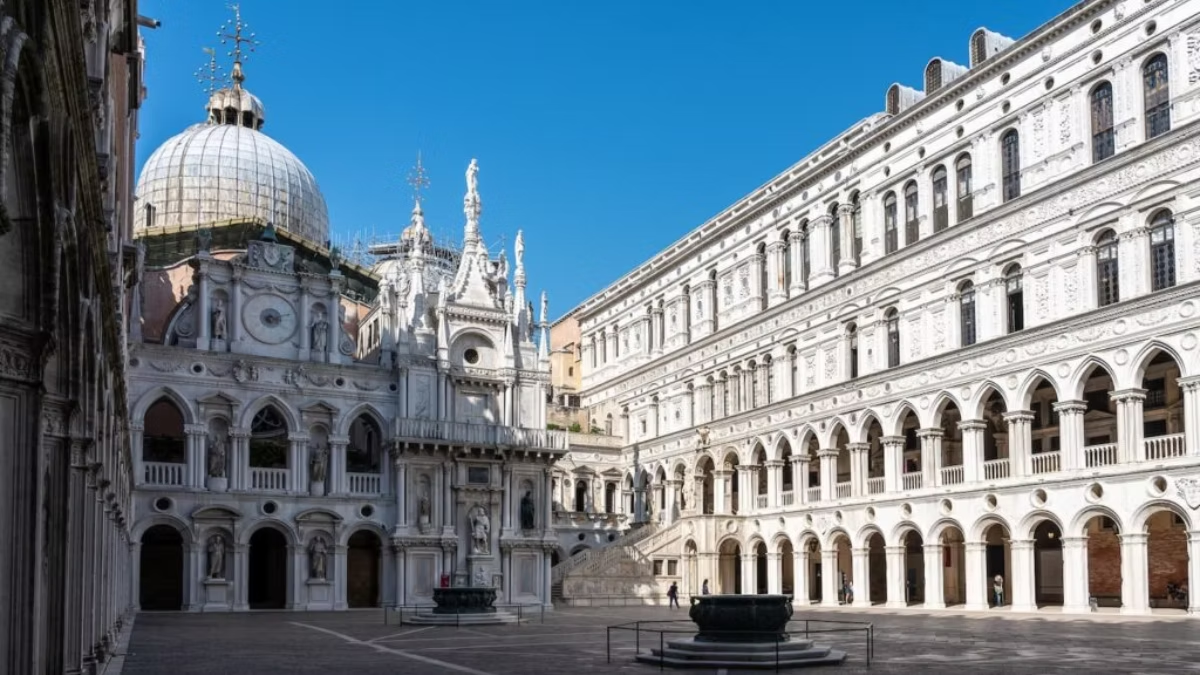
The exterior of the Doge’s Palace — the façades visible from St. Mark’s Square, the Molo, and the Piazzetta — is accessible and viewable without a palace ticket. Free-access features include the full exterior façade of Venetian Gothic pink-and-white stonework, the Porta della Carta (ceremonial entrance by the Buon family, 1438–1442), the courtyard (enterable during opening hours), the Scala dei Giganti (Giants’ Staircase) with Sansovino’s Mars and Neptune statues, the Foscari Arch, the Manopola clock tower, and the carved capitals on the lower arcades. This guide covers every major exterior feature and the best ways to see each.
Most visitors focus entirely on what’s inside the Doge’s Palace. But the palace’s exterior is arguably its most iconic feature — the Venetian Gothic façade is what appears in tourist photographs, paintings by Canaletto and Turner, and global cultural references. A thoughtful exploration of the exterior takes 30–60 minutes and can be done before, after, or instead of the paid interior visit. This guide is for anyone wanting to understand and appreciate the palace’s external architecture in detail.
What You Can See Free (No Ticket Needed)
Substantial portions of the palace’s exterior are accessible without any ticket. You can walk the entire perimeter of the building along St. Mark’s Basin, the Piazzetta, and St. Mark’s Square. The courtyard is freely enterable during opening hours through the open passages — allowing views of the Giants’ Staircase (but you cannot ascend it). The Porta della Carta is visible from the courtyard side. The carved capitals on the lower arcades are visible from street level. The one major element requiring a ticket is the Museo dell’Opera (the museum displaying the original capitals, reached through the paid entrance).
Freely accessible
- Full exterior façade (all four sides)
- Courtyard (during opening hours)
- Giants’ Staircase view from ground level
- Manopola clock tower view
- Foscari Arch view
- Lower-arcade carved capitals
- Exterior of the Bridge of Sighs (from Ponte della Paglia and Ponte della Canonica)
- Porta della Carta from the courtyard side
Requires paid ticket
- Museo dell’Opera (original capitals)
- Interior rooms (state rooms, apartments, etc.)
- Bridge of Sighs interior crossing
- New Prisons
- Climbing the Scala dei Giganti
The Porta della Carta
The Porta della Carta (“Paper Gate”) is the palace’s ceremonial entrance, located between the palace and St. Mark’s Basilica. Built between 1438 and 1442 by Giovanni and Bartolomeo Buon — the same architects responsible for much of the façade. Originally known as the “Golden Doorway” (Porta d’Oro) for its extensive gilding and polychromy — very little of which survives today. The gate is crowned by a sculpture of Doge Francesco Foscari kneeling before the Lion of St. Mark (the current figure is a 19th-century replacement by Luigi Ferrari, replacing the original destroyed in 1797).
Architectural features
- Gothic pinnacles flanking the main doorway
- Four Cardinal Virtues (Prudence, Charity, Temperance, Fortitude) in canopied niches along the side pillars
- Justice crowning the doorway with sword and scales
- St. Mark the Evangelist in a roundel below Justice
- Doge Foscari kneeling above the main doorway (19th-century replacement)
- Rich Gothic tracery throughout
The name
Two theories about the name “Porta della Carta”:
- “Carta” = paper: because scribes set up desks here to handle legal document writing for citizens
- “Cartabum” archives: because state archives were kept nearby
Both theories are plausible; the true origin may involve both.
The Doge Foscari statue
Above the main doorway, Doge Francesco Foscari (reigned 1423–1457) is depicted kneeling before the Lion of St. Mark. This iconographic pose expresses core Venetian constitutional theory:
- The Doge served the Republic, not the reverse
- No ruler, however powerful, could place himself above Venice
- The institution endured while individuals came and went
Important: The current statue is a 19th-century replacement by Luigi Ferrari. The original was destroyed during the Napoleonic occupation of 1797.
Today’s access
The Porta della Carta is closed to visitors as an entrance — preserved as a historical monument. Today’s visitor entrance is the Porta del Frumento on the south (waterfront) side. You see the Porta della Carta from the courtyard side, after entering via Porta del Frumento.
The Exterior Façades
The south façade (overlooking St. Mark’s Basin)
The oldest and most iconic façade of the palace:
- Rebuilt from 1340 onwards
- Length: Approximately 75 meters
- Overlooks St. Mark’s Basin: the harbor with San Giorgio Maggiore visible across the water
- Best photographed from the Molo (the waterfront walkway) or from a boat on the Basin
- Morning light illuminates this façade best
The west façade (overlooking the Piazzetta)
The façade facing the Piazzetta San Marco (the small square between the palace and the lagoon):
- Completed by 1424
- Length: Approximately 75 meters
- Faces the Biblioteca Marciana (Sansovino’s library) across the Piazzetta
- Best photographed from the Piazzetta or from the Columns of St. Mark and St. Theodore
- Afternoon light illuminates this façade best
The east façade (overlooking the Rio di Palazzo)
The canal-side wing, housing the Doge’s Apartments internally:
- Built between 1483 and 1565
- Renaissance style rather than Gothic
- Less photographed but visible from the Ponte della Paglia and the Canal
- Bridge of Sighs connects this side to the New Prisons across the canal
The north façade
Faces St. Mark’s Basilica — the two buildings are connected by the Porta della Carta:
- Partially obscured by the basilica’s structure
- Courtyard visible through the Foscari Arch
- Least-photographed of the four sides
The Carved Capitals
The capitals on the lower arcade columns are among the palace’s most significant individual artworks. There are 36 capitals on the ground floor and 71 capitals on the first floor — each one different, featuring carved scenes depicting philosophy, astronomy, trades, virtues, vices, months of the year, zodiac signs, and flora and fauna. Most of the capitals you see today on the façade are 19th-century copies; the originals (14th–15th century) are preserved indoors in the Museo dell’Opera to protect them from weathering. The most famous capital is Capital 18 from the Porta della Carta corner — the “Capital of the Vices” showing the Seven Deadly Sins.
Types of capital imagery
The capitals form a comprehensive didactic program — effectively a “book in stone”:
- Philosophers and thinkers: classical sages and medieval philosophers
- Trades and crafts: masons, carpenters, shipbuilders, goldsmiths
- Virtues and vices: personified moral qualities
- Months and zodiac: agricultural cycle and astrological lore
- Flora and fauna: plants, animals, birds, sea creatures
- Biblical and mythological scenes
- Allegorical narratives
Capital 18: The Capital of the Vices
The capital at the corner by the Porta della Carta depicts the Seven Deadly Sins personified — Pride, Avarice, Lust, Envy, Gluttony, Wrath, and Sloth — each shown with specific iconographic attributes and consequences. This served as moralistic teaching for Venetian citizens passing by the palace.
Other notable capitals
- Capital of the Planets: at the Piazzetta/Molo corner, showing the heavens and creation of man
- Capital of Ages: showing human life stages
- Capital of the Months: showing agricultural activities month by month
- Zodiac capitals: the twelve signs with associated imagery
- Trades capitals: showing the various craftsmen who built Venice
Originals vs copies
In the 19th century, many weathered capitals were replaced with copies to preserve the originals. The originals are now displayed in the Museo dell’Opera — the small museum at the start of the paid visitor route.
If you want to see the original capitals (rather than just their copies on the façade), you need a palace ticket and time in the Museo dell’Opera.
The Corner Sculpture Groups
The three corners of the southern and western façades feature major sculpture groups, each with thematic significance:
Southwest corner (Porta della Carta side)
- The Judgment of Solomon: the biblical scene of Solomon threatening to divide a child between two claiming mothers, revealing the true mother by her horror
- The Archangel Gabriel: above the group
- Capital below: Justice and the Lawgiver
- Meaning: Justice as the foundation of good government
Southeast corner (Piazzetta–Molo junction)
- Adam and Eve: the original couple before the Fall, expressing human innocence and eventual sin
- The Archangel Michael: above
- Capital below: Creation of man and the planets
- Meaning: Human origins and moral nature
Northeast corner (Rio di Palazzo junction)
- The Drunkenness of Noah: the biblical scene of Noah drunk and naked, shame covered by his sons
- Capital below: Related biblical imagery
- Meaning: Human frailty and the importance of covering shame with moral order
These three groups collectively frame the palace’s iconography — judgment, origin, and frailty — all fundamental themes for a building that housed the Republic’s law courts, residence of the Doge, and cells for criminals.
The Courtyard
The central courtyard is accessible through the Porta della Carta and the Foscari Arch, opening from the narrow passage between the palace and St. Mark’s Basilica. It’s freely enterable during palace opening hours (09:00–18:00/19:00). The courtyard is dominated by the Scala dei Giganti (Giants’ Staircase) — the ceremonial staircase with Sansovino’s colossal statues of Mars and Neptune at the top. The Foscari Arch frames one entrance; the Manopola clock tower rises above one side. The courtyard also contains two ornate bronze well-heads (vere da pozzo) that historically provided fresh water. Spend 15–20 minutes here for full appreciation.
Key courtyard elements
- Scala dei Giganti: the ceremonial staircase (1485–1491 by Antonio Rizzo)
- Mars and Neptune statues: by Jacopo Sansovino (1554–1567)
- Foscari Arch: ceremonial entrance arch (mid-15th century, completed under Doge Giovanni Mocenigo)
- Manopola façade and clock tower: 17th-century addition (1608–1615)
- Two bronze well-heads: 16th-century, formerly providing fresh water
- Lateral walls with Renaissance sculptural reliefs
- Ceremonial center of the palace
Free access
The courtyard is freely accessible during opening hours. You enter through:
- The Porta della Carta (ceremonial but closed as a current entrance)
- The Porta del Frumento if you have a ticket
- Side passages from Piazza San Marco directly
What you cannot do without a ticket
- Ascend the Scala dei Giganti: it’s roped off for non-ticketed visitors
- Enter the palace proper via any of the courtyard doorways
- Visit the Museo dell’Opera (entered through Porta del Frumento)
But you can view everything at ground level for free, take photographs, and spend as long as you want in the courtyard proper.
The Scala dei Giganti (Giants’ Staircase)
The Scala dei Giganti is the ceremonial staircase in the courtyard where newly elected Doges were crowned. Built between 1485 and 1491 by Antonio Rizzo after the 1483 fire. The staircase takes its name from the two colossal statues of Mars and Neptune added by Jacopo Sansovino between 1554 and 1567, flanking the top of the staircase. The symbolic meaning: Mars represents Venice’s military power on land; Neptune represents maritime power on sea — together, the dual foundations of Venetian imperial authority.
Historical use
- Doge coronations: newly elected Doges were crowned with the ducal cap at the top of the staircase
- Public proclamations: major state announcements were made from the staircase
- Reception of honored visitors: foreign dignitaries were received here
- Execution of Marin Falier: the 55th Doge, convicted of treason, was beheaded at the top of the staircase in April 1355
The Mars and Neptune statues
- Mars (the Roman god of war): representing Venice’s military power
- Neptune (the Roman god of the sea): representing Venetian maritime dominance
- Carved 1554–1567 by Sansovino
- Colossal in scale: roughly 3.5 meters tall each
- Made of Istrian stone matching the palace façade
These statues are among Sansovino’s most important Venice works and are the architectural climax of the courtyard.
See Golden Staircase (Scala d’Oro): Complete Guide for the separate ceremonial staircase inside the palace.
The Foscari Arch
A monumental triumphal arch frames one entrance to the courtyard, named for Doge Francesco Foscari (reigned 1423–1457):
- Begun under Doge Foscari
- Completed under Doge Giovanni Mocenigo (1478–1485)
- Late Gothic / proto-Renaissance style
- Architectural function: Ceremonial framing of the passage between the Porta della Carta and the main courtyard
- Surmounted by sculptural decorations including allegorical figures
The Foscari Arch creates a choreographed ceremonial entrance — visitors pass through the Porta della Carta, under the Foscari Arch, and into the courtyard proper, building visual anticipation.
The Manopola Clock Tower
On the north side of the courtyard, a marble façade designed by Bartolomeo Manopola (built 1608–1615) features a clock tower with a mechanism by German watchmaker Johan Slim (1614). This represents the Renaissance-Mannerist additions to the originally Gothic courtyard. The clock is still functional. The façade’s architectural style deliberately contrasts with the Gothic elements around it, marking the 17th-century evolution of Venetian architecture.
Design features
- White marble façade with blind arches
- Clock at the apex with original 17th-century mechanism
- Architectural style: Early Baroque / Mannerist
- Functional: The clock still operates
The clock mechanism
The 1614 mechanism by Johan Slim was technologically innovative for its time:
- Weight-driven through a system descending into the foundation
- The weights extended down into an underlying canal (later covered)
- Advanced precision by 17th-century standards
- Still operational today
Bronze Well-Heads (Vere da Pozzo)
Two ornate bronze well-heads stand in the courtyard — 16th-century castings that historically provided fresh water to the palace. Details:
- Cast bronze with elaborate relief decoration
- Commissioned by specific doges whose arms appear on the castings
- Historically functional: drawing water from cisterns below
- Preserved as historical artifacts: not used as water sources today
- Representative of Venetian civic engineering: the palace had sophisticated freshwater management
How to See the Exterior
Recommended walking route
A full exterior tour takes 30–45 minutes:
- Start in St. Mark’s Square: overall view of west façade plus Porta della Carta (10 min)
- Walk to Porta della Carta: study the gate closely (5 min)
- Enter the courtyard through the passage (free): Foscari Arch, Giants’ Staircase, Mars and Neptune, Manopola tower, well-heads (15–20 min)
- Exit to Piazzetta side: west façade and corner sculptures (10 min)
- Walk along the Molo: south façade and lagoon view (10 min)
- Continue to Ponte della Paglia: Bridge of Sighs view from outside & east façade (5 min)
- Return to Porta del Frumento: if entering for a paid visit (5 min)
Photography tips
- Morning light (08:00–11:00): best for the south façade and courtyard
- Afternoon light (14:00–17:00): best for the west façade and Porta della Carta
- Late evening: palace illumination creates dramatic photographs
- Wide-angle lenses help capture the full façade height
- Telephoto for the corner sculpture groups and high details
Avoiding crowds
- Before 09:00: palace exterior before interior opens, fewer tourists in the Piazzetta
- After 19:00 in winter / 22:00 in summer evenings
- Early morning is also the best light for exterior photography
Frequently Asked Questions
Can I visit the exterior without a ticket?
Yes, substantially. The full exterior façade, the courtyard (during opening hours), and all the corner sculpture groups are freely accessible. Only the Museo dell’Opera (original capitals) and the interior rooms require a paid ticket.
What’s the Porta della Carta?
The palace’s ceremonial entrance between the palace and St. Mark’s Basilica. Built 1438–1442 by Giovanni and Bartolomeo Buon. Not currently used as a visitor entrance — that’s the Porta del Frumento on the waterfront side.
Are the capitals on the façade original?
Most are 19th-century copies. The originals (14th–15th century) are preserved in the Museo dell’Opera inside the palace, protected from weathering.
What are the Giants’ Staircase statues?
Colossal statues of Mars and Neptune by Jacopo Sansovino (1554–1567). Mars represents Venice’s land power; Neptune represents maritime power.
Is the courtyard free to enter?
Yes, during palace opening hours. You can walk freely into the courtyard through the passages. You cannot ascend the Giants’ Staircase (roped off) or enter the palace interior without a ticket.
What’s the story about Doge Foscari kneeling?
Doge Francesco Foscari is depicted kneeling before the Lion of St. Mark above the Porta della Carta. The pose expresses Venetian constitutional theory — the Doge served the Republic, not the reverse. The current statue is a 19th-century replacement by Luigi Ferrari; the original was destroyed in 1797.
What’s the Capital of the Vices?
Capital 18 on the lower arcade near the Porta della Carta — showing the Seven Deadly Sins personified. One of the most famous individual capitals on the façade. The original is in the Museo dell’Opera.
How long does an exterior-only visit take?
30–45 minutes for a thorough walking tour. 60 minutes if you’re stopping for extensive photography. Less than 15 minutes if you’re just taking a few quick photos.
Does the 17th-century clock still work?
Yes. The Johan Slim 1614 mechanism is still functional. It’s visible on the Manopola clock tower on the courtyard’s north side.
Can I photograph the exterior freely?
Yes. No restrictions on exterior photography. Tripods are generally fine on the public walkways; be aware that major tourist bridges like the Ponte della Paglia have very heavy foot traffic.
How does the palace compare to other Venetian Gothic buildings?
The palace is the largest and most architecturally ambitious Venetian Gothic structure. Similar style, smaller scale: Ca’ d’Oro (on the Grand Canal), Ca’ Foscari, and various private palaces along the Grand Canal.
Is the façade architecturally consistent?
Mostly yes — the south and west façades (the famous sides) were built coherently between 1309 and 1424. The east canal-side wing is Renaissance, architecturally different. The Bridge of Sighs (1600–1603) is Baroque. Each period’s style is recognizably distinct.
