

Hall of the Senate (Sala del Senato): Complete Guide to the Doge’s Palace
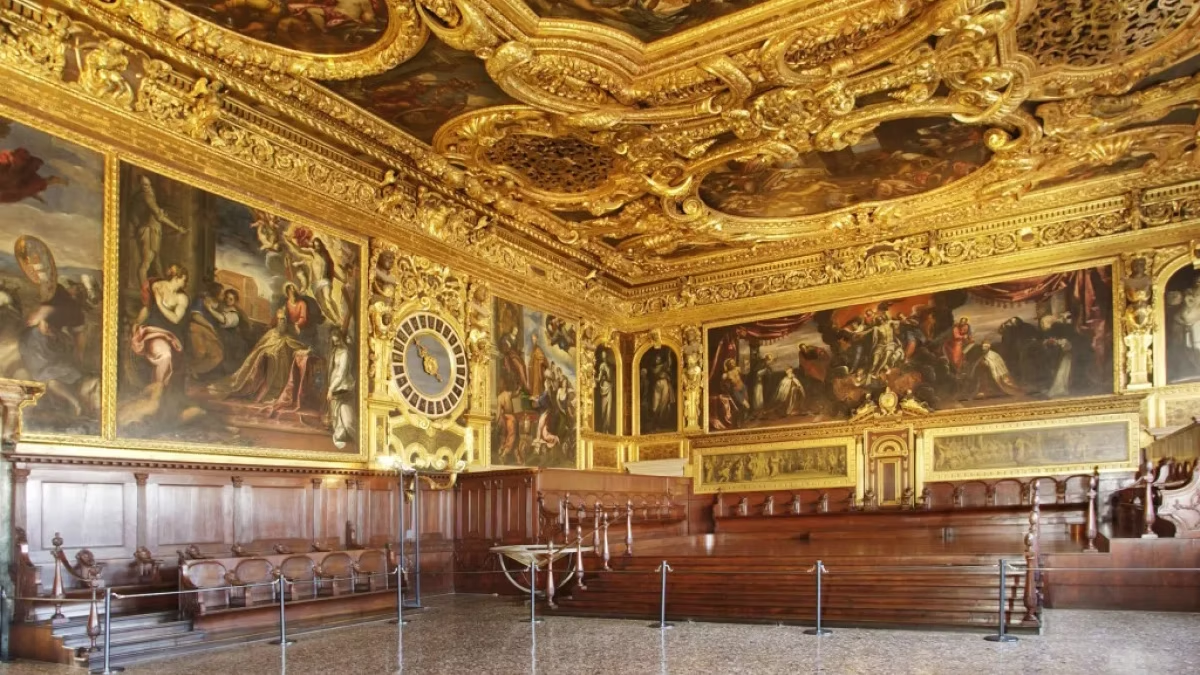
The Sala del Senato — also known as Sala dei Pregadi (“Hall of the Invited”) — was the meeting chamber of the Venetian Senate, one of the oldest public institutions in Venice, founded in the 13th century. By the 16th century, the Senate (roughly 120 senators drawn from the wealthiest families) oversaw foreign policy, trade, manufacturing, and treasury matters. The room’s pictorial decoration was completed in 1595 after the 1574 fire, designed by a team led by Jacopo Tintoretto with significant work by his son Domenico, plus Palma il Giovane and Marco Vecellio. The ceiling centerpiece is Tintoretto’s “The Triumph of Venice as Queen of the Sea” (1587–1594). Plan 10–15 minutes here on a standard visit.
After the Collegio’s ceremonial reception of ambassadors, the Sala del Senato is where Venice’s actual foreign-policy decisions were made. The room is smaller in scale than the Chamber of the Great Council but denser with political history — every painting on the walls and ceiling reflects the Senate’s self-image as the governing body responsible for Venice’s Mediterranean empire. This guide covers exactly what you’re looking at, the room’s political function, and how it fits into the standard visitor route.
The Room’s Function
The Venetian Senate was the core body responsible for the Republic’s foreign policy, treasury, trade regulation, and war declarations. Roughly 120 senators met here twice a week throughout the Republic’s existence. Membership was drawn from the wealthiest and most politically experienced members of the nobility — effectively the upper tier of Venice’s governing class. The name “Pregadi” comes from the Doge’s practice of pregare (praying, inviting) specific senators to attend — originally a small invited committee, later expanded into the permanent Senate.
| Feature | Details |
|---|---|
| Alternative name | Sala dei Pregadi |
| Senate membership | ~120 senators (by 16th century) |
| Meeting frequency | Twice weekly |
| Founded | 13th century |
| Primary functions | Foreign policy, treasury, trade, war |
| Location in palace | Second floor, after the Sala del Collegio |
| Typical visit time | 10–15 minutes |
Historical evolution
The Senate began in the 13th century as a small advisory committee to the Doge, gradually expanding as Venice’s maritime empire grew. By the 14th–15th centuries it had become the principal body handling:
- Foreign policy: alliances, treaties, diplomatic appointments
- Military decisions: war declarations, troop deployment, fleet operations
- Treasury: revenue, expenditure, financial policy
- Trade regulation: commercial law, taxes, guild affairs
- Manufacturing oversight: the Arsenale, the glass industry, state-regulated trades
The Senate was structurally a sub-committee of the Great Council, but practically the most powerful day-to-day body in Venetian government. While the Great Council met on Sundays and high holidays to approve legislation, the Senate met twice a week and handled the actual business of governing.
Why “Sala dei Pregadi”
The name “Pregadi” reflects an unusual feature of the room’s history. In the institution’s early centuries, the Doge would personally pregare (“invite” or more literally “pray”) specific senators to attend meetings — rather than having a fixed membership. Over time, the invited members became a permanent body, but the name stuck. The term captures the Republic’s deliberately informal self-image: senators were invited advisors to the Doge rather than commanded subjects.
The Ceiling
The wooden ceiling is divided into painted panels set in gilded frames. The central large panel is Tintoretto’s “The Triumph of Venice as Queen of the Sea” (also called “Venice Receiving the Gifts of the Sea”) painted 1587–1594 — largely executed by his son Domenico and the family workshop. Smaller surrounding panels feature allegorical figures and scenes celebrating the Republic’s virtues, glory, and military victories. The ceiling decoration was completed in 1595 as part of the post-fire reconstruction program.
Central panel: “The Triumph of Venice as Queen of the Sea”
Painted by Tintoretto (with heavy workshop involvement) between 1587 and 1594. Depicts Venice personified as an enthroned female figure receiving tribute from Neptune and other maritime gods — a direct visual assertion of the Republic’s self-image as ruler of the Adriatic and Mediterranean.
Key symbolic elements:
- Venice enthroned: central female figure, crowned, seated on clouds
- Neptune and sea deities: presenting treasures (coral, pearls, gold)
- Allegorical figures of Abundance and Justice: Venice’s claimed virtues
- Cherubim and angels: divine endorsement
The work complements the Chamber of the Great Council’s Paradise in theme — both connect Venetian governance to divine approval and cosmic order. Where Paradise emphasizes the religious dimension, “Triumph of Venice” emphasizes the commercial and maritime dimension.
Surrounding ceiling panels
Smaller paintings around the central work include:
- Virtues personified: Justice, Prudence, Peace, Abundance
- Allegorical scenes: of Venetian commercial and military success
- Decorative gilt work: surrounding each panel
Expect to spend 3–5 minutes looking up at the ceiling. The room is smaller than the Chamber of the Great Council, so the ceiling panels are closer and more easily viewed.
Wall Paintings
The walls display a coordinated cycle of paintings by Tintoretto, Palma il Giovane, Marco Vecellio, and Domenico Tiepolo. The theme throughout is divine protection of Venice and the religious legitimacy of Senate decisions. Christ appears as a dominant figure in the Tintoretto works — reflecting the idea that the Senate (which elected the Doge) operated under divine guidance. Several paintings depict specific historical moments when Venice sought or received divine intervention.
Key wall paintings
| Work | Artist | Subject |
|---|---|---|
| The Dead Christ Adored by Doges Pietro Lando and Marcantonio Trevisan | Tintoretto | Christ with two 16th-century doges |
| Allegory of Victory over the League of Cambrai | Palma il Giovane (c. 1590) | Doge Leonardo Loredan commemorating 1509 war |
| Doge Loredan Praying to the Virgin | Tintoretto workshop | Plague and Turkish threat; divine intercession |
| Doge Pasquale Cicogna Asking Christ to Save the City | Palma il Giovane | Famine and pestilence relief |
| Various allegorical figures | Various | Virtues, military successes |
Allegory of Victory over the League of Cambrai (Palma il Giovane, c. 1590)
One of the most historically significant wall paintings — commemorates Venice’s survival of the War of the League of Cambrai (1508–1516), when a coalition of European powers (the Papacy, France, Spain, and the Holy Roman Empire) combined to destroy the Republic. Venice lost major mainland territories temporarily but survived as a state. Doge Leonardo Loredan is the central protagonist — the same Doge whose famous portrait by Giovanni Bellini (now in London’s National Gallery) is one of the iconic Venetian Renaissance images.
The painting presents the Cambrai survival as divine miracle rather than military-diplomatic achievement — reinforcing the Senate’s theological framing of Venetian history.
Furnishings and Layout
The original 16th-century wooden seating arrangement is partially preserved:
- Rows of carved wooden benches: along the side walls
- Elevated platform: at the east end for the Doge and senior officers
- Central open floor space: for speakers addressing the Senate
- Hidden storage cabinets: behind wall panels for documents
Much of the original furniture has been restored or replaced over centuries. What you see today is an approximation of 16th–17th century appearance, not an unbroken original.
Position in the Visitor Route
The Sala del Senato comes third in the sequence of state rooms on the second floor, after the Sala delle Quattro Porte (antechamber) and the Sala del Collegio (formal reception). Visitors typically arrive here approximately 60–75 minutes into a standard self-guided visit, or 30–45 minutes into a guided tour. The room is entered from the Sala del Collegio and exits into a narrow connecting passage toward the Sala del Consiglio dei Dieci.
Sequence of state rooms:
- Sala delle Quattro Porte (antechamber)
- Sala dell’Anticollegio (ambassadors’ waiting room)
- Sala del Collegio (Doge’s reception room)
- Sala del Senato ← you are here
- Sala del Consiglio dei Dieci (Council of Ten)
- Sala della Bussola (denunciation-slot room)
- Armoury (four connected rooms)
- Sala dello Scrutinio (ballot-counting room)
- Chamber of the Great Council
See Doge’s Palace Rooms Guide for the full room-by-room overview, and Doge’s Palace Map & Floor Plan for the building layout.
How to Look at the Room
Recommended approach:
- Start at the entrance: absorb the overall composition of the room
- Look up at the central ceiling panel: Tintoretto’s Triumph of Venice
- Walk the long sides: follow the sequence of wall paintings
- Pay attention to the throne position: at the east end, where the Doge presided
- Note the ceiling frame gilding: original 16th-century craftsmanship
- Final check: look for the Palma il Giovane “League of Cambrai” work
Most visitors spend 8–12 minutes in the room, though it rewards 15–20 minutes for those interested in Venetian political history.
Guided tours typically spend 5–8 minutes here before moving to the Sala del Consiglio dei Dieci. If you want longer, stay after your guide finishes — your ticket remains valid.
Historical Context
Before the 1574 fire
The room’s original decoration dated to the 15th century, including paintings by earlier Venetian masters. Documentary evidence suggests Carpaccio, Bellini, and Titian may have contributed.
The 1574 fire
On 11 May 1574, a fire damaged sections of the palace including rooms around the Sala del Senato. Not as catastrophic as the 1577 fire that destroyed the Chamber of the Great Council, but still requiring extensive restoration.
The reconstruction (1580s–1595)
Reconstruction followed a coordinated program:
- 1580s: structural repairs and ceiling framing
- Late 1580s–early 1590s: Tintoretto’s ceiling and major wall paintings
- 1595: decoration completed
The coordination across multiple artists (Tintoretto, Palma il Giovane, Vecellio, Tiepolo) reflects the Senate’s programmatic approach to the room’s iconography — every painting was chosen to reinforce specific political-theological messages.
After the Republic (1797–present)
When Napoleon ended the Venetian Republic in 1797, the Senate ceased to exist. The room served various administrative functions under Austrian rule and after Italian unification. In 1923 the palace became a museum, and the Sala del Senato was restored as a historical exhibit.
Frequently Asked Questions
What is the Sala del Senato?
The Sala del Senato (Hall of the Senate), also known as the Sala dei Pregadi, was the meeting chamber of the Venetian Senate — the body responsible for foreign policy, treasury, and trade for the Republic of Venice.
What does “Pregadi” mean?
The term comes from the Italian pregare, meaning “to ask” or “to invite.” The name reflects that the Doge originally invited specific senators to attend meetings, rather than having a fixed membership body.
How many senators met here?
By the 16th century, approximately 120 senators. They met twice a week throughout the Republic’s existence.
Who painted the ceiling?
Jacopo Tintoretto designed the central panel, with major execution by his son Domenico Tintoretto and the family workshop. The central work is “The Triumph of Venice as Queen of the Sea,” painted 1587–1594. The entire decoration program was completed in 1595.
What’s the most important painting here?
Tintoretto’s central ceiling panel “The Triumph of Venice as Queen of the Sea” is the programmatic centerpiece. Palma il Giovane’s “Allegory of Victory over the League of Cambrai” is the most historically significant wall painting.
How does this room differ from the Chamber of the Great Council?
The Chamber of the Great Council held up to 2,000 nobles and handled legislation and magistrate elections. The Sala del Senato held roughly 120 senators and handled the actual day-to-day business of governing — foreign policy, treasury, trade. Smaller room, more specialized function.
What happened here historically?
Foreign policy decisions, treaty ratifications, war declarations, treasury allocations, trade regulations, ambassadorial appointments. The Senate met twice weekly throughout the Republic’s existence (13th century — 1797).
How long should I spend here?
10–15 minutes is standard. Enthusiasts of Venetian political history can easily spend 20–30 minutes. Guided tours typically spend 5–8 minutes before moving on.
Can I sit in the original senator benches?
No — the benches are historical exhibits and not for visitor seating. Staff will redirect visitors who attempt to sit.
Is the room photographable?
Yes, without flash. No tripods or selfie sticks. Phone photography works well despite moderate lighting. See Dress Code, Bag Policy & Visitor Rules.
Why is Christ so prominent in the paintings here?
The Senate was the body that elected the Doge (through a complex multi-stage process). The heavy Christological iconography reflects the Senate’s theological framing of this responsibility — Venetian doges were elected through processes understood as divinely guided rather than purely political.
