

Veronese’s Ceilings in the Doge’s Palace: Complete Guide to His Masterworks
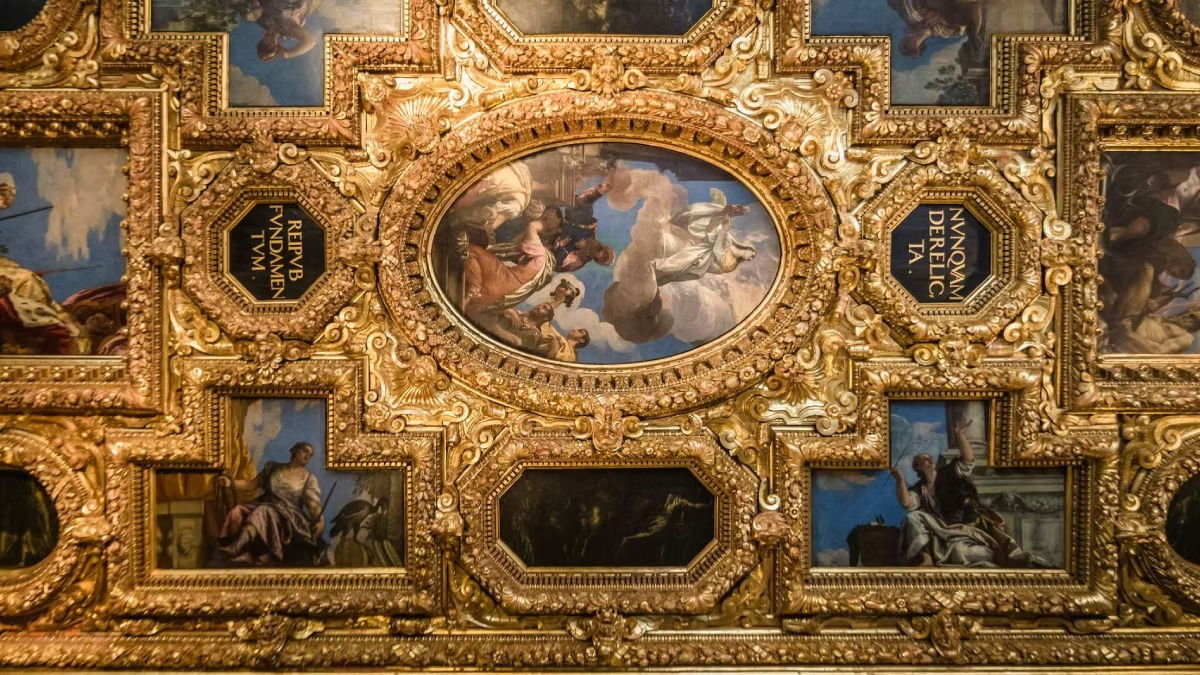
Paolo Veronese (1528–1588) created some of the most important ceiling programs in European art within the Doge’s Palace. His absolute masterpiece there is the Sala del Collegio ceiling (1575–1578), a coherent allegorical program celebrating the Good Government of Venice, with the central Triumph of Faith surrounded by four personified virtues (Simplicity, Dialectic, Vigilance, Docility). Other major Veronese works in the palace include the Apotheosis of Venice oval ceiling in the Chamber of the Great Council (1582), the Rape of Europa and Venice Distributing Honours and Rewards in the Sala dell’Anticollegio, and the Votive Portrait of Doge Sebastiano Venier (1581–1582). This guide covers each major Veronese work, its iconography, and how it fits in the palace’s overall decorative program.
Paolo Veronese’s ceiling work at the Doge’s Palace represents one of the peak achievements of Venetian ceiling painting — an art form Venice essentially pioneered and dominated during the 16th century. Unlike Tintoretto (dramatic, dark, emotionally intense) or Titian (portrait-focused, psychologically searching), Veronese specialized in light-filled, color-saturated, dramatically complex ceiling compositions that transformed interior spaces. The palace contains several of his best examples. This guide covers each program with its iconography, historical context, and viewing advice.
Paolo Veronese: The Painter
Paolo Caliari (1528–1588), called “Veronese” after his hometown Verona, was one of the three dominant Venetian painters of the later 16th century (alongside Titian and Tintoretto). Known for light-filled, color-saturated, architecturally complex compositions with graceful figures and dramatic foreshortening. Where Tintoretto worked fast and dark, Veronese worked slow and luminous. Where Titian focused on portraits and religious works, Veronese specialized in large decorative programs for palace ceilings, church walls, and banqueting halls. Died 1588 at age 60 — just before he was to begin work on Tintoretto’s Paradise (which Tintoretto then took over).
Biographical essentials
- Born 1528 in Verona
- Moved to Venice: around 1553
- Key early commissions:: Villa Barbaro at Maser (ceiling frescoes with Andrea Palladio’s architecture, 1560s); Wedding at Cana for the Monastery of San Giorgio Maggiore (1563, now in the Louvre)
- Peak Venice period: 1565–1585: major palace and church commissions
- Died 1588 in Venice at age 60
Stylistic characteristics
Veronese’s style includes:
- Luminous color palette: golds, pinks, silver-greys, deep blues
- Dramatic foreshortening: on ceiling figures (learned partly from Mantegna and Correggio)
- Architectural settings: integrated with painted figures (deepened by his collaboration with Palladio)
- Elegant, courtly figures: rather than Tintoretto’s dramatic, muscular ones
- Complex multi-figure compositions: with graceful grouping
For ceiling painting specifically, Veronese became the Venetian master — and the Doge’s Palace holds some of his most important ceiling work.
The Sala del Collegio Ceiling (1575–1578)
The Sala del Collegio ceiling is Veronese’s masterpiece in the Doge’s Palace — a coherent allegorical program celebrating the Good Government of the Venetian Republic. Commissioned after the 1574 fire destroyed the earlier decoration. Architectural room design by Andrea Palladio and Antonio Rusconi; wooden frame and gilding by Francesco Bello and Andrea da Faenza; paintings by Veronese 1575–1578. Iconographic program centers on Faith as the foundation of good government, with personified Virtues as its supporting pillars.
The room’s function
The Sala del Collegio was where the Pien Collegio (Full Council) met — a body of senior ministers responsible for foreign affairs, mainland territorial governance, and maritime policy. Foreign ambassadors were formally received here by the Doge and the Collegio.
The iconographic program
The ceiling celebrates Venetian Good Government as divinely ordained and virtuously pursued:
| Panel | Subject | Position |
|---|---|---|
| Triumph of Faith (central) | Faith conquering heresy and unbelief | Center oval |
| Simplicity | Virtue of honest, direct governance | Upper left corner |
| Dialectic | Virtue of reasoned argument and logic | Upper right corner |
| Vigilance | Virtue of alert watchfulness | Lower right corner |
| Docility | Virtue of receptivity to counsel | Lower left corner |
Triumph of Faith
The central panel shows Faith personified as a female figure holding a chalice (symbol of the Eucharist) and a book (scripture), trampling heresy and personified vices beneath her feet. The figure is crowned by angels. The composition uses strong foreshortening so Faith appears to ascend toward the ceiling viewer.
The four Virtue panels
Each T-shaped panel in the corners presents a personified virtue:
- Simplicity: holding a lamb or a book; the basic virtue of straightforward honest rule
- Dialectic: with attributes of logic and debate; reasoning as governmental tool
- Vigilance: with open eyes and lamps; alert governance
- Docility: receptive posture, ready to hear advice
Why it matters
- Technical tour-de-force: Veronese’s mature ceiling technique at its peak
- Coherent iconographic program: unusual for 16th-century multi-artist decorations
- Preserved original condition: unlike some works damaged by fire or removed by Napoleon, this ceiling remains largely as Veronese left it
- Represents peak Veronese: painted during his most productive decade
Viewing advice
The Sala del Collegio is small enough that the ceiling is close and visible from below. Benches allow comfortable ceiling viewing. Plan 15–20 minutes in this room:
- Enter and look up at the central Triumph of Faith
- Work clockwise around the four Virtue panels
- Note the gilded wooden frames: integrated with the paintings
- Look down at the floor and tribune: where the Doge sat during Collegio meetings
- Finally view Veronese’s Votive Portrait of Doge Sebastiano Venier: on the wall above the tribune
Apotheosis of Venice (1582)
Veronese’s magnificent ceiling centerpiece in the Chamber of the Great Council — the palace’s largest room. Venice personified as a crowned female figure is crowned by Victory, surrounded by allegorical figures. Below the ascending Venice, a balcony filled with Venetian nobility and ordinary citizens looks up, creating a visual connection between the painted allegory and the room’s actual inhabitants. Painted 1582 for the room’s post-fire reconstruction program; paired with Tintoretto’s wall-filling Paradise (1588–1592) below.
The composition
The oval central panel shows:
- Venice crowned in glory: a female figure ascending in light
- Victory crowning her: with a golden crown
- Allegorical figures: Peace, Justice, Abundance, Glory in attendance
- The crowd below: a balcony-full of Venetian nobility and ordinary citizens looking up, a painted audience for the apotheosis
- Sky and heavenly light: dramatic upward movement
Why it matters
- Pairs thematically with Tintoretto’s Paradise: both assert Venetian divine/cosmic legitimacy
- One of the most ambitious ceiling illusions of the 16th century
- Demonstrates Veronese’s mastery of foreshortened figures
- The balcony-crowd device is a Veronese signature: blending viewer and subject
Viewing advice
After studying Tintoretto’s Paradise on the end wall, turn and look up at the central ceiling oval. The Chamber of the Great Council has benches that allow comfortable ceiling viewing. Budget 5–7 minutes of dedicated ceiling viewing in this room.
See Chamber of the Great Council: Complete Guide for the full room.
Rape of Europa (1580)
Considered one of the palace’s finest Veronese works. Located in the Sala dell’Anticollegio (the antechamber where foreign ambassadors waited). Depicts Jupiter disguised as a bull carrying Europa across the sea to Crete — a classical myth often read as an allegory of cultural-maritime connection, paralleling Venice’s role as a Mediterranean trading republic. Painted 1580 as part of the Anticollegio’s decoration program. The Sala dell’Anticollegio is small but densely packed with important art — Veronese’s Rape of Europa plus four major Tintoretto mythological works (Bacchus and Ariadne, Mercury and the Three Graces, Forge of Vulcan, Minerva Expelling Mars) moved here in 1716.
The composition
Europa, a Phoenician princess, is seduced by Jupiter who has transformed himself into a gentle white bull. She climbs on his back decorated with flowers, and he carries her across the sea to Crete. Veronese’s version shows the decorative, courtly moment just before the abduction — Europa is still gentle, the bull still apparently tame. The mythological story appears more as allegorical pageant than dramatic event.
Why it’s significant
- Technical brilliance: in the handling of color and texture (the white bull, the flowers, the princess’s drapery)
- Characteristic Veronese grace: courtly, elegant, atmospheric rather than dramatic
- Iconographic depth: the myth connects to Venetian Mediterranean identity
- Well-preserved: original condition
Viewing advice
The Sala dell’Anticollegio is small, so you’re naturally close to the painting. Compare with the Tintoretto mythological works in the same room — stylistic contrast between the two masters is striking. Veronese’s light, decorative palette vs Tintoretto’s darker, more dramatic tonalities.
Venice Distributing Honours and Rewards (c. 1586)
Location: Sala dell’Anticollegio ceiling
Central ceiling fresco showing Venice personified distributing gifts of honour to worthy recipients — an allegorical statement about the Republic’s meritocratic ideals. Less technically ambitious than the Sala del Collegio ceiling but iconographically important.
Why it matters
- Part of the Anticollegio’s programmatic decoration
- Thematically integrates with the room’s function (reception of foreign dignitaries)
- Shows Veronese’s capacity to handle propaganda subjects with grace
Votive Portrait of Doge Sebastiano Venier (1581–1582)
Located on the wall above the tribune in the Sala del Collegio — where the Doge actually sat. The painting shows Doge Sebastiano Venier kneeling in thanks to Christ for the Venetian victory at the Battle of Lepanto (1571). Venier (c. 1496–1578) commanded the Venetian fleet at Lepanto and was later elected Doge (1577–1578). The painting was commissioned just after his death and completed 1581–1582.
Historical significance
- Battle of Lepanto: the defining Venetian naval victory over the Ottoman Empire (7 October 1571)
- Sebastiano Venier: Venetian commander at the battle, elected Doge 1577
- The painting ties the palace’s decoration directly to this defining historical moment
- Positioned where the Doge actually sat: meaning the Republic’s most important recent military victory was visually invoked at every Collegio meeting
Compositional features
- Venier kneeling: humble posture appropriate to a votive (thank-offering) painting
- Christ appearing in glory: traditional votive iconography
- Standards and flags: hinting at the naval victory
- Allegorical figures: alongside the main figures
Why it matters
- Direct connection between the palace and the Battle of Lepanto trophies in the Armoury
- Shows Veronese integrating contemporary history into religious iconography
- Demonstrates how Venetian political self-image connected to specific recent military events
Other Veronese Works in the Palace
Beyond the four major programs, Veronese contributed to several other areas:
Sala del Consiglio dei Dieci (Council of Ten) — originally
The room’s ceiling originally contained “Jupiter Fulminating the Vices” by Veronese, painted around 1553 when he was just 25–26. This was one of his earliest major commissions and showed his emerging style. The original was removed by Napoleon in 1797 and is now in the Louvre — a copy replaced it in the palace.
Sala delle Quattro Porte — contributions
The room’s decoration was primarily by Tintoretto but included Veronese contributions. Less artistically unified than the Sala del Collegio program.
Various attributions
Some palace works are attributed to Veronese with varying confidence — some are autograph, others workshop, others by followers. Scholarly attribution has refined over the centuries.
Veronese vs Tintoretto: The Venetian Dual Style
The palace gives a rare opportunity to see Veronese and Tintoretto side by side in the same rooms — the two major artistic rivals of late 16th-century Venice. Key contrasts:
| Feature | Veronese | Tintoretto |
|---|---|---|
| Color palette | Luminous, light-filled | Dark, dramatic |
| Figure style | Elegant, courtly | Muscular, dramatic |
| Composition | Architectural, balanced | Dynamic, often diagonal |
| Pace of work | Slower, more labored | Faster, often sketchy |
| Religious vs secular | Equally comfortable | Religious preference |
| Workshop role | Mostly autograph | Significant workshop |
Both artists competed for major commissions. The Paradise competition is the defining moment — Veronese originally won (jointly with Francesco Bassano), died before starting, and Tintoretto inherited the commission.
For Tintoretto’s Paradise specifically: Chamber of the Great Council: Complete Guide.
How to See the Veronese Ceilings
Art-focused time allocation
| Room | Time |
|---|---|
| Sala del Collegio (masterpiece ceiling + Venier portrait) | 20 minutes |
| Sala dell’Anticollegio (Rape of Europa + ceiling) | 15 minutes |
| Chamber of the Great Council (Apotheosis ceiling) | 10 minutes (alongside Paradise) |
| Sala del Consiglio dei Dieci (copy of original) | 5 minutes |
Total for Veronese-focused sections: ~50 minutes.
Viewing technique
- Look up from different positions: ceiling paintings read differently from various angles
- Use benches: where available
- Study individual figures: once the overall composition registers
- Compare light effects: Veronese’s paintings especially reward attention to how light falls on figures
- Note architectural integration: the paintings work with the room’s architecture, not against it
Photography
- No flash: (as throughout the palace)
- Wide-angle essential: for capturing full ceilings
- Vertical format: works for single central panels
- Patience with crowds: tour groups cluster in these rooms
Historical Context
The 1574 and 1577 fires
The palace’s Veronese programs were commissioned in response to two devastating fires:
- 1574 fire: damaged the Sala del Collegio and surrounding rooms
- 1577 fire: destroyed the Chamber of the Great Council’s decoration
Veronese’s Collegio ceiling (1575–1578) responded to the first fire; the Apotheosis of Venice (1582) and related work responded to the second. Both reconstructions represented massive coordinated decorative programs — Veronese, Tintoretto, Palma il Giovane, Francesco Bassano all contributing.
After Veronese’s death
Veronese died in 1588 at age 60. His son Carletto (Carlo Caliari) and workshop continued some projects. His nephew Alvise Benfatto del Friso also continued the family workshop tradition. However, Veronese’s most important works at the palace were all completed during his lifetime.
Napoleonic losses
Napoleon’s 1797 conquest removed certain works to France:
- Veronese’s Jupiter Fulminating the Vices: (Sala del Consiglio dei Dieci, ~1553): Louvre
- Various other works dispersed
What remains in the palace represents survivors of Napoleonic selection.
Frequently Asked Questions
What’s Veronese’s single most important work in the Doge’s Palace?
The Sala del Collegio ceiling (1575–1578) is widely considered his masterpiece in the palace. A coherent program of Faith and Virtues celebrating Venetian Good Government.
Why is there a copy of Veronese’s Jupiter in the Sala del Consiglio dei Dieci?
Napoleon removed the original in 1797; it’s now in the Louvre. A copy replaced it at the palace. This pattern of substitution after Napoleonic loss applies to several Venetian works.
What’s the relationship between Veronese and Tintoretto?
Rivals and contemporaries. Both active in Venice through the later 16th century. Both competed for major commissions. Veronese died 1588; Tintoretto died 1594. The Paradise commission passed from Veronese to Tintoretto after Veronese’s death.
Which Veronese works are original vs workshop?
The Sala del Collegio ceiling is largely autograph. The Rape of Europa is autograph. The Apotheosis of Venice in the Chamber of the Great Council involved workshop assistance. The Votive Portrait of Sebastiano Venier is autograph.
How long does Veronese-focused viewing take?
Approximately 50 minutes for the major Veronese works spread across the Sala del Collegio, Sala dell’Anticollegio, and Chamber of the Great Council. For enthusiasts, an hour-plus is reasonable.
Can I photograph the ceilings?
Yes, without flash. Wide-angle lenses help capture full ceilings. No tripods or selfie sticks. See Dress Code, Bag Policy & Visitor Rules.
Are the ceiling paintings frescoes or oil on canvas?
Oil on canvas, set into gilded wooden frames. This was the Venetian preference — more durable in Venice’s damp climate than fresco. Tintoretto’s Paradise is also oil on canvas (sewn-together sheets).
How does the Collegio ceiling compare to Veronese’s work elsewhere?
The Doge’s Palace Collegio ceiling is widely considered among Veronese’s finest ceiling programs. Comparable masterworks include his ceilings at the Villa Barbaro at Maser (private commission for the Barbaro family, 1560s) and his earlier church of San Sebastiano ceiling (1555–1570). The Doge’s Palace ceiling is more politically inflected than these.
What did Veronese paint outside Venice?
Important works in Verona, the Villa Barbaro, the Louvre’s Wedding at Cana (originally at San Giorgio Maggiore in Venice), and various church commissions. His output was predominantly Venice-based once he moved there in the 1550s.
