

Visiting Doge’s Palace with Kids 2026: Honest Family Guide
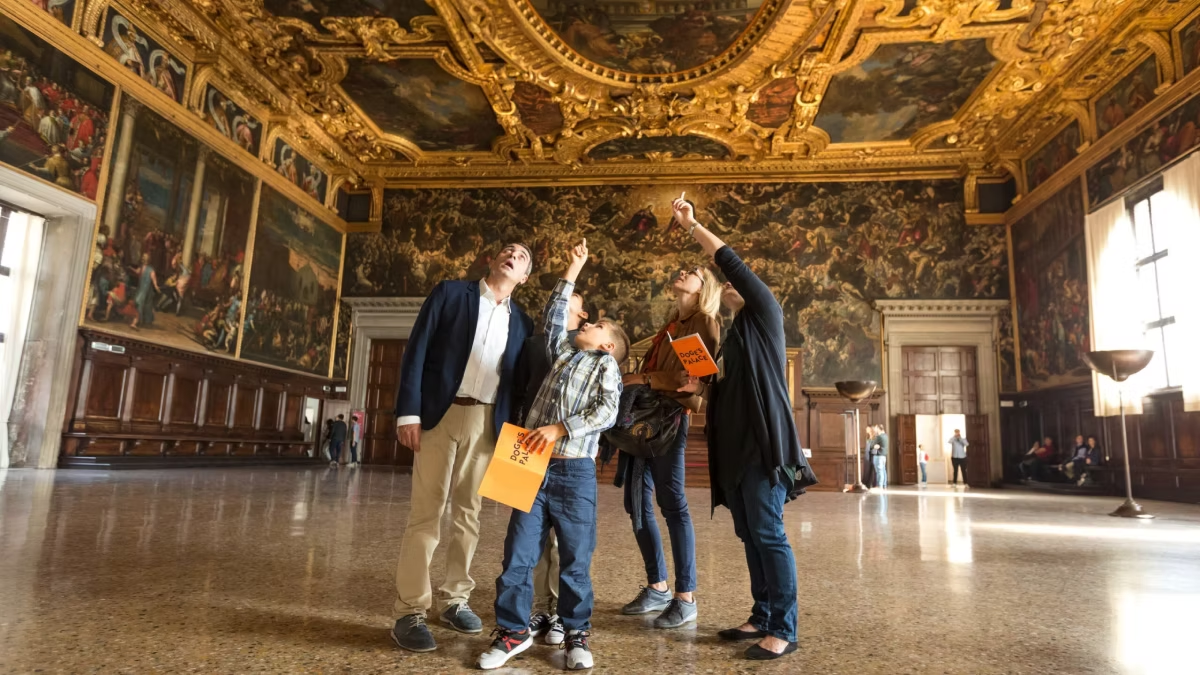
The Doge’s Palace is family-friendly for children 6 and up. Children under 6 enter free; ages 6–14 enter at the reduced price of €15. Realistic engagement time is 60–90 minutes for under-10s, 90–120 minutes for ages 10–14. The rooms kids respond to most are the Armoury (2,000+ weapons), the Bridge of Sighs, and the New Prisons — essentially the “story” parts. The ceremonial rooms and ceiling art need more patience. Strollers work on the main accessible route but can’t cross the Bridge of Sighs or enter the prisons — a baby carrier solves this. The Secret Itineraries Tour excludes children under 6 entirely.
Venice isn’t an obviously child-friendly destination — it’s historical, adult-oriented, and has no theme parks or interactive museums in the modern sense. That said, the Doge’s Palace holds up better with kids than most museums in Venice because the building itself tells stories kids engage with: weapons, prisons, secret passages, a famous bridge with a sad name, and rooms where people were actually judged and executed. This guide covers realistic expectations for different ages, what works and what doesn’t, and practical tips for a successful family visit.
Ticket Prices for Children
Children under 6 enter the Doge’s Palace free. Children ages 6–14 pay the reduced price of €15. Students ages 15–25 also qualify for the €15 reduced rate. Family tickets don’t exist as a specific category — you pay per-person with age-appropriate pricing for each child. Valid ID proving age is required at entry for reduced tickets. Infants in carriers or strollers are always free.
| Age | Price | Notes |
|---|---|---|
| Under 6 | Free | No ticket needed at all |
| 6–14 | €15 | Reduced rate; proof of age required |
| 15–17 | €15 | Student reduced rate |
| 18+ | €30–35 | Standard adult price |
Children under 6 don’t need a ticket at all — just walk in with the paying adult. For ages 6+, purchase the reduced ticket online alongside the adult ticket. The same reduction applies on the official website and most third-party platforms.
See Doge’s Palace Ticket Prices 2026 for complete pricing.
Realistic Engagement Time by Age
Under 6: 30–45 minutes before tiredness kicks in. Ages 6–10: 60–90 minutes. Ages 11–14: 90–120 minutes. Ages 15–17: 2–2.5 hours, approaching adult attention span. Plan to exit before kids genuinely crash — leaving slightly early beats pushing through a tantrum. Your ticket remains valid for the day, so a pre-booked return to finish the visit after a break is technically possible but rarely used in practice.
| Age | Typical Engagement | Best Strategy |
|---|---|---|
| 3–5 years | 30–45 min | Focus on courtyard + 2–3 highlight rooms |
| 6–8 years | 60–75 min | Prioritize Armoury + Bridge of Sighs |
| 9–12 years | 75–90 min | Standard route with narrative framing |
| 13–15 years | 90–120 min | Close to adult engagement |
| 16–17 years | 2–2.5 hours | Full standard route |
Children’s engagement isn’t linear — most kids have 2–3 “peak interest” moments followed by fatigue. The Armoury and prisons usually spike interest; grand ceremonial rooms usually dip it. Plan to end the visit near a high point (the Bridge of Sighs is naturally the emotional climax of the standard route).
What Kids Actually Enjoy
Kids respond most to the parts of the palace with clear stories or dramatic content: the Armoury (weapons and armor), the Bridge of Sighs (its famous sad name), the New Prisons (cells, corridors, interrogation rooms), and the Chamber of the Great Council (the “biggest room they’ll ever see”). The ceilings, ceremonial protocol rooms, and fine-detail Veronese paintings tend to bore younger kids. Leaning into the “story” elements during your visit significantly extends engagement.
High-engagement sections for kids
- Armoury (Armeria): 2,000+ historical weapons, crossbows, armor, cannons. Nearly universal appeal for kids 6+.
- Bridge of Sighs: the name, the small latticed windows, the story of condemned prisoners seeing Venice for the last time. Kids love dark stories told respectfully.
- New Prisons: actual prison cells with original graffiti. The story of Casanova’s escape (covered on guided tours) is memorable.
- Chamber of the Great Council: not interesting for the art per se, but very impressive for its sheer size (“this is the biggest room in Europe without internal supports”).
- Courtyard and Giants’ Staircase: Mars and Neptune statues, the dramatic open space. Good arrival moment.
Lower-engagement sections for kids
- Doge’s Apartments: nicely decorated but “just rooms” to most kids
- Sala dell’Anticollegio and Sala del Collegio: Veronese ceilings are magnificent but require looking up for extended periods
- Sala del Senato: political history beyond most children’s interest
- The art-dense transition rooms: dense painted ceilings lose kids fast
Framing the visit as a story
Kids engage better when adults frame the visit around narrative rather than architecture. Examples:
- “This is where the ruler of Venice lived: the Doge”
- “They had a thousand people voting in this room”
- “These are the cells where they kept prisoners for years”
- “This is the bridge where condemned prisoners got their last look at Venice: that’s why it’s called the Bridge of Sighs”
A few minutes of story framing before entering each major section typically doubles engagement.
The Secret Itineraries Tour and Kids
The Secret Itineraries Tour explicitly excludes children under 6. For ages 6–10, it’s permitted but the content (torture chamber, dark prison cells, steep narrow stairs) is genuinely unsettling for many children in that age range. The tour is best suited to ages 12+. Parents should preview the tour content before booking — some families love it, others find it distressing for their specific child. The Hidden Treasures Tour has similar child-restriction rules.
- Under 6:: Not permitted on the tour at all
- Ages 6–10:: Permitted but content includes torture apparatus and disturbing historical context; claustrophobia in narrow passages is real
- Ages 11–12:: Often engaged by the history, handles the content well
- Ages 13+:: Strong engagement typical, approaches adult interest
If your child is interested in history and handles dark historical content maturely, the tour can be a highlight. If your child is sensitive or prone to claustrophobia, skip it.
See Secret Itineraries Tour: Complete Guide for full tour details.
Strollers and Prams
Strollers are allowed on the main accessible route of the Doge’s Palace via elevators. However, strollers cannot cross the Bridge of Sighs or enter the New Prisons (stairs-only). For those sections, use a baby carrier or park the stroller temporarily. A parking area for strollers may be available at the prison entrance — ask staff. The basilica next door has similar stroller restrictions for the upper terrace.
- Bring a compact folding stroller: rather than a bulky one: easier to maneuver through security screening and doorways
- Use elevators with staff assistance: ask at the entrance
- Transition to a baby carrier: before reaching the Bridge of Sighs section
- Leave strollers in a parking area: if staff offer one, or fold and carry
- Avoid peak midday (11:00–15:00): crowded rooms make stroller navigation difficult
Some families simply skip the Bridge of Sighs and prison sections entirely with very young children, which is a reasonable choice given that the external view of the Bridge of Sighs (from the Ponte della Paglia outside) is arguably more photogenic than the internal crossing anyway.
Best Time to Visit with Kids
Early morning (09:00 opening) is the single best time to visit with kids. Children are freshest, crowds are lowest, interior temperatures are coolest. Avoid midday (11:00–15:00) when the palace is most crowded and hot. Late afternoon (15:00–17:00) is the second-best window. Extended Friday/Saturday evenings (May–September 2026) are also family-friendly — fewer crowds, though later than many kids can sustain.
For broader seasonal timing: Best Time to Visit Doge’s Palace.
Practical day-of strategy:
- Book the earliest available slot (09:00–09:30)
- Feed the kids a proper breakfast beforehand
- Aim to be inside and moving by 09:15
- Focus on high-engagement sections first, before kids tire
- Plan to exit by 11:30–12:00 at the latest for under-8s
- Have a lunch spot already identified for immediately after
What to Bring
Useful items for a family visit:
- Water bottles: refillable, small enough to fit in a daypack
- Light snacks: for after the visit, not inside (food prohibited in visitor rooms)
- Baby carrier: for the sections strollers can’t access
- Change of clothes: for younger children (spills, bathroom accidents)
- Small entertainment item: a sticker book or activity book for a quick distraction if engagement dips
- Camera/phone: kids often enjoy taking their own photos
- Light jacket or layer: palace interior can be cooler than outside
What to leave at the hotel
- Large backpacks (over 1m combined dimensions)
- Large diaper bags: bring a compact one instead
- Rolling suitcases
- Bulky toys
Rules Specific to Families
Standard palace rules, applied to families:
- No running or loud play: the palace is a historic site
- No touching artworks, walls, or furniture: applies to all ages
- Speak quietly: staff may remind loud families
- No food or drinks in visitor rooms: the ground-floor café is the eating area
- Children must remain with adults: at all times
Baby facilities:
- Baby pit-stop: a dedicated nappy-change / feeding area; ask staff for location
- Accessible restrooms: on each floor, with baby-change facilities
- Quiet spaces: for breastfeeding are limited; the palace café is the most practical
Combo Visits with St. Mark’s Basilica
Most families visit the palace and basilica together. Considerations for families:
- Basilica dress code: applies: shoulders and knees must be covered for all ages
- Bring a light scarf: that can double as shoulder cover
- Basilica photography is restricted: phone photos in the main areas often not permitted
- Basilica has no cloakroom: bring minimal bags
- Terrace is not stroller-accessible: upper gallery is stairs-only
- Timed entry at the basilica: plan slot timing to match your post-palace arrival
For combo booking strategy: Doge’s Palace + St. Mark’s Combo Tickets: Full Comparison and Best Doge’s Palace Tours for Families & First-Time Visitors.
Guided Tours with Kids
For families considering a guided tour instead of self-guided:
- Standard group tours: 75–90 minutes; most include children 6+ without issue, larger groups can lose kids’ attention
- Small-group tours: better for kids; more personal, less noise
- Family-specific tours: some operators offer tours specifically for families with activities/narrative framed for children
- Private tours: best for families with specific needs; most expensive option
- Evening tours: possibly too late for younger kids; suit families with older children (12+)
Guide selection matters: ask the tour operator about their experience with family groups when booking. Many guides enjoy adapting commentary to engage kids and can significantly improve the family experience.
See Best Doge’s Palace Tours for Families & First-Time Visitors for tour recommendations.
Eating Near the Palace with Kids
Post-visit meal options in the area:
- Palace ground-floor café: convenient, limited menu, kid-friendly enough
- Trattorias in the Castello district: (5–10 minutes’ walk): more authentic, better value, better food
- Gelato options: Venice is full of these; guaranteed kid-pleaser after the visit
- Avoid restaurants directly on St. Mark’s Square: priced for tourists, quality variable
For specific restaurant recommendations: Where to Eat Near Doge’s Palace.
Frequently Asked Questions
Are children free at the Doge’s Palace?
Children under 6 enter free. Ages 6–14 enter at the reduced rate of €15 (valid ID/proof of age required). Students ages 15–25 also get the €15 rate.
What’s the minimum age for the Doge’s Palace?
There’s no minimum age — infants and babies are welcome. For the Secret Itineraries and Hidden Treasures tours, children under 6 are specifically excluded.
Can I bring a stroller?
Yes, on the main accessible route. Strollers can’t cross the Bridge of Sighs or enter the New Prisons (stairs-only). Use a baby carrier for those sections or skip them.
How long will kids stay engaged?
Realistic: 60–90 minutes for under-10s, 90–120 minutes for ages 10–14. Plan to exit before fatigue dominates.
What do kids like best?
The Armoury (weapons/armor), Bridge of Sighs, New Prisons, and Chamber of the Great Council (for size). Framing the visit as stories rather than architecture helps engagement significantly.
Is the palace suitable for toddlers?
With realistic expectations (30–45 minutes before they’re done), yes. Very young children under 3 often find a 30-minute visit manageable.
Is the Secret Itineraries Tour appropriate for kids?
Not for under 6 (excluded). Ages 6–10 may find content disturbing — weapons, prison cells, claustrophobic spaces. Best for ages 12+.
Are there changing facilities?
Yes — a baby pit-stop is available. Ask staff at the entrance or check the map on arrival. Accessible restrooms also have changing facilities.
Can we bring food and drinks for the kids?
Not into visitor rooms. The ground-floor café is the designated eating/drinking area. You can exit and re-enter with your valid ticket to eat outside.
Is the basilica dress code strictly enforced for kids?
Yes. Children’s shoulders and knees must be covered at the basilica same as adults. Bring a light scarf or wrap to comply.
What about teenagers — will they be bored?
Probably not if you pick the right sections. The Armoury and prisons typically engage teenagers. A guided tour with a good storyteller is often the best format for teenagers.
Can kids photograph inside?
Yes. Phone photography is fine throughout (no flash, no selfie sticks). Kids often enjoy being given responsibility for taking photos during the visit.
What if my child has a meltdown?
Exit calmly via the main entrance. Your ticket remains valid for re-entry throughout the day. A 30-minute break outside (gelato helps) often reboots the visit.
