

Doge’s Palace Architecture & Venetian Gothic Style: Complete Guide
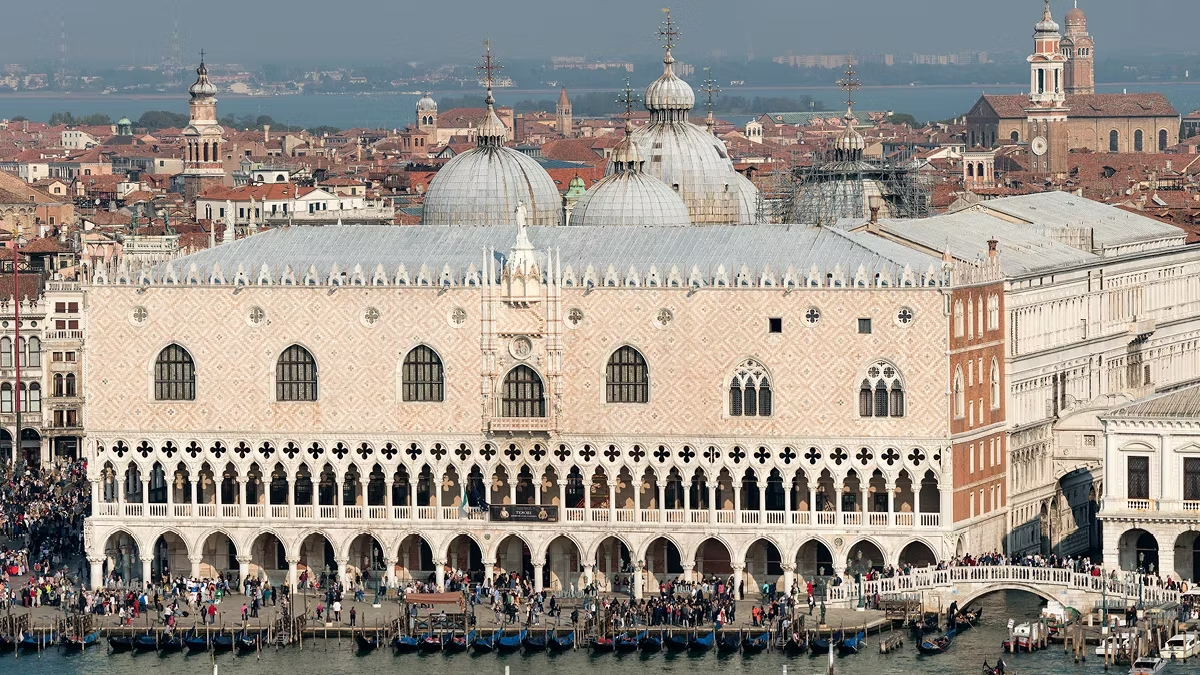
The Doge’s Palace is the defining example of Venetian Gothic architecture — a distinctive late-medieval style blending Gothic pointed arches, Byzantine decorative elements, and Islamic geometric patterns unique to Venice’s position between East and West. The main façades overlooking St. Mark’s Basin and the Piazzetta were built between 1309 and 1424, principally by the architects Giovanni and Bartolomeo Buon (or “Bon”). The façade’s signature feature is the distinctive pink and white diamond pattern created with pink Verona marble and white Istrian stone on the upper walls, resting on two lower storeys of open arcades with elaborately carved capitals. This “inverted” structure — heavy mass above, open arcades below — is architecturally striking and specifically Venetian.
The Doge’s Palace is one of the most instantly recognizable buildings in Europe. Its silhouette has been copied in hotels from Las Vegas to Disney’s Epcot, painted by Canaletto, Turner, and countless others, and photographed perhaps more times than any building in Venice. What makes it unique isn’t just beauty — it’s the specific architectural experiment the Venetians undertook: combining Northern European Gothic with Byzantine decoration and Islamic geometric patterns into a coherent civic style. This guide explains the architecture element by element.
What Is Venetian Gothic?
Venetian Gothic is a specific architectural style that flourished in Venice from roughly the 14th through the 15th centuries, combining French/Northern European Gothic elements (pointed arches, vertical emphasis, ornamental tracery) with Byzantine influences (domed structures, mosaic decoration, geometric patterns inherited from the Eastern Roman Empire) and Islamic geometric patterns (acquired through Venice’s extensive Mediterranean trade with Egypt, Syria, and the Ottoman world). The result is a style recognizably Gothic in structure but distinctively Oriental in decoration — unlike anything north of the Alps.
Distinguishing features
- Pointed Gothic arches: often with more elaborate tracery than French Gothic
- Lighter wall surfaces: than continental Gothic, with greater use of decorative stonework
- Quatrefoil tracery: four-lobed ornamental patterns in window and screen stonework
- Diamond or lozenge patterns: in façade stonework (pink and white being most iconic)
- Open loggias and balconies: integrated into façade design
- Eastern-influenced ornament: including patterns borrowed from Islamic architecture
- Colored stone inlays: rather than the uniform materials of Northern European Gothic
Key Venetian Gothic buildings
The Doge’s Palace is the most famous example, but other notable Venetian Gothic buildings include:
- Ca’ d’Oro: (1421–1440): palatial residence on the Grand Canal
- Ca’ Foscari: (c. 1453): another Grand Canal palace
- Palazzo Ducale: (Doge’s Palace): our subject
- Santi Giovanni e Paolo church: Gothic religious architecture
- Various other palaces along the Grand Canal
The Doge’s Palace stands out because its scale and public function turned individual Venetian Gothic elements into a coherent civic style — a building that announces “Venice” visually wherever its image appears.
The Three Wings
The palace consists of three distinct wings enclosing a central courtyard. The oldest wing faces St. Mark’s Basin (the lagoon-facing south side) and was substantially rebuilt starting in 1340. The western wing faces the Piazzetta San Marco and was completed by 1424. The eastern canal-side wing houses the Doge’s Apartments and government offices, built later in Renaissance style (1483–1565). Each wing reflects the architectural style of its construction period — with the south and west façades being the classic Venetian Gothic exteriors that appear in tourist photographs.
| Wing | Period | Style | Primary Function |
|---|---|---|---|
| South (Basin-facing) | Rebuilt from 1340 | Venetian Gothic | Original institutional rooms |
| West (Piazzetta) | Completed 1424 | Venetian Gothic | Extended institutional rooms |
| East (Canal-side) | 1483–1565 | Renaissance | Doge’s Apartments and offices |
| Connecting Bridge of Sighs | 1600–1603 | Baroque | Link to New Prisons |
The architectural diversity is a feature, not a flaw — the palace evolved over centuries as Venetian power and governance needs expanded.
The South and West Façades (1309–1424)
The two most photographed façades of the palace — facing St. Mark’s Basin (south) and the Piazzetta (west) — were built between 1309 and 1424, principally by Giovanni and Bartolomeo Buon (the Buon family of architects) and their collaborators. The façades share a unified design: a two-storey lower arcade of open arches resting on stone columns with elaborately carved capitals, supporting a massive upper storey with the distinctive pink-and-white diamond pattern punctuated by ornamental Gothic windows. The total façade length is approximately 152 meters.
The two-storey arcade
The ground-floor and first-floor arcades are one of the palace’s architectural signatures:
- Ground floor:: Lower arcade with 36 arches supported by pink-marble columns
- First floor:: Upper arcade with 71 slimmer arches (double the number of lower arches)
- Columns:: All different: each carved with distinct capital designs
- Loggia spaces:: Open walkways providing shelter from sun and rain for pedestrians
The doubling of arches — 36 below, 71 above — creates a dynamic rhythm rather than a static pattern. Walking around the exterior, you see the arches multiply as you look up.
The pink and white upper storey
Above the arcades, the upper façade is covered in a distinctive diamond/lozenge pattern of pink Verona marble against white Istrian stone:
- Pink Verona marble: pale rose color, from quarries near Verona
- White Istrian stone: fine-grained limestone from the Istrian peninsula (modern Croatia)
- Pattern:: Geometric lozenges created by diagonal cuts of each stone
- Effect:: The massive upper wall appears lighter and more decorative than its weight would suggest
The contrast of the open arcades below with the solid upper storey creates a visually “inverted” building — heavy above, light below — unusual for medieval civic architecture. This is a deliberate choice reflecting Venice’s architectural confidence.
The capitals
The 36 ground-floor and 71 first-floor column capitals are among the palace’s most artistically significant features:
- All different: each capital features distinct carved scenes
- Subject matter:: Philosophy, astronomy, fauna, trades, virtues, vices, months, zodiac
- Period: 14th–15th century original carvings
- Conservation:: Many originals replaced with copies in the 19th century to protect the original stone from weathering
- Originals:: On display in the palace’s Museo dell’Opera (ground-floor museum at the start of the visitor route)
Capital 18: The “Capital of the Vices”
The 18th capital from the Porta della Carta (sometimes called the “Capital of the Vices”) is the most famous individual capital. It depicts moralistic scenes including:
- The Seven Deadly Sins: personified
- Scenes of judgment and punishment
- Allegorical warnings: for Venetian citizens
This capital was particularly important in Venetian civic iconography — a reminder that even walking past the palace carried moral lessons about the consequences of vice. The original is preserved in the Museo dell’Opera; a copy stands in its position on the façade.
The sculpture groups
The corner piers at the corners of the palace feature major sculptural groups:
- Porta della Carta corner:: Judgment of Solomon, with the Archangel Gabriel above
- Piazzetta-Molo corner:: Adam and Eve, with the Archangel Michael above
- Rio di Palazzo corner:: The Drunkenness of Noah (the biblical scene of Noah’s shame)
These sculpture groups are attributed variously to Filippo Calendario, Matteo Raverti, and the Lombardo family — the leading Venetian sculptors of the period. They create a moralistic narrative around the building’s corners.
The Porta della Carta (1438–1442)
The Porta della Carta (“Paper Gate”) is the palace’s ceremonial entrance, located between the palace and St. Mark’s Basilica. Built between 1438 and 1442 by Giovanni and Bartolomeo Buon — the same family of architects responsible for much of the façade — it represents the culmination of late Venetian Gothic style. The name probably derives from either scribes who set up their desks here to handle legal document writing for citizens, or from the archives of state documents (cartabum) kept nearby. Originally gilded and painted — it was also called the “Golden Doorway” (Porta d’Oro) during the Republic — though the gilding was stripped or damaged over centuries.
Design elements
The Porta della Carta includes:
- Flanking Gothic pinnacles: with elaborate finials
- Four statues of the Cardinal Virtues: (Prudence, Charity, Temperance, Fortitude) in canopied niches along the side pillars
- A figure of Justice: crowning the main doorway
- St. Mark the Evangelist: in a roundel below Justice
- Doge Francesco Foscari: (reigned 1423–1457) depicted kneeling before the Lion of St. Mark above the doorway
- Rich Gothic tracery: throughout
The kneeling Doge
The figure of Doge Francesco Foscari kneeling before the Lion is iconographically significant. The pose expresses a core principle of Venetian constitutional theory: the Doge served the Republic, not the reverse. Showing the Doge in humble kneeling posture before Venice’s symbolic lion reinforced that no Doge, however powerful, could position himself above the Republic.
Important note: The current statue is a 19th-century replacement by sculptor Luigi Ferrari. The original was destroyed in 1797 during the Napoleonic occupation.
The gilding
The Porta della Carta was originally extensively gilded and painted in bright colors — hence the “Golden Doorway” alternative name. Very little of this original polychromy survives. The current stone-colored appearance reflects centuries of weather, wartime damage, and incomplete restoration campaigns. The building originally looked dramatically more colorful than it does today — a fact that surprises most visitors.
The Courtyard
The central courtyard is accessible through the Porta della Carta and the Foscari Arch. The space is dominated by the Scala dei Giganti (Giants’ Staircase), the ceremonial staircase where Doges were crowned. Two colossal statues of Mars and Neptune by Jacopo Sansovino (1554–1567) flank the top of the staircase, symbolizing Venice’s dual power on land and at sea. A 17th-century marble façade designed by Bartolomeo Manopola (1608–1615) on the courtyard’s north side features a clock tower and represents later Renaissance-Mannerist additions to the originally Gothic structure.
Key courtyard elements
- Scala dei Giganti: ceremonial staircase (1485–1491 by Antonio Rizzo; statues 1554–1567 by Sansovino)
- Foscari Arch: monumental entrance arch (mid-15th century, completed under Doge Giovanni Mocenigo 1478–1485)
- Bronze well-heads: (vere da pozzo): 16th century, still producing fresh water historically
- Manopola façade + clock tower: (1608–1615): north side of courtyard
- Various Renaissance-era sculptural reliefs: on the walls
- Free to enter: the courtyard is accessible without palace admission during opening hours
See Façade & Courtyard: Complete Guide for a dedicated guide to these exterior elements.
The Canal-Side Wing (1483–1565)
The eastern wing of the palace, facing the Rio di Palazzo and housing the Doge’s Apartments, was largely rebuilt in Renaissance style after a 1483 fire destroyed the earlier structures. Key features:
- Architect:: Initially Antonio Rizzo (after the 1483 fire); later additions by various architects
- Style:: Venetian Renaissance, replacing the earlier Gothic
- Function:: Doge’s residential apartments + government offices
- Visible from outside:: Less dramatic than the Gothic façades but architecturally coherent
- Interior access:: Part of the standard visitor route
The Renaissance style is deliberately different from the Gothic — reflecting the architectural evolution of Venice between the mid-15th and mid-16th centuries.
The Bridge of Sighs and New Prisons (1600–1614)
The bridge connecting the palace to the New Prisons is Baroque in style, completing the palace’s three-style architectural progression:
- Venetian Gothic: (south and west façades, 1309–1424)
- Renaissance: (east canal-side wing, 1483–1565)
- Baroque: (Bridge of Sighs, 1600–1603; New Prisons, 1563–1614)
The Bridge of Sighs is white Istrian stone with refined Baroque detailing — a later style reflecting the architectural preferences of around 1600.
See Bridge of Sighs & New Prisons: Complete Guide for detail on this section.
Architectural Influences
Venetian Gothic architecture drew from three main influences. Gothic structural principles (pointed arches, vertical emphasis, ornamental tracery) came from Northern European Gothic via Italian mainland cities. Byzantine influences (domes, mosaic decoration, certain column types) came from Venice’s long political and commercial relationship with the Byzantine Empire (which controlled nearby Dalmatian and Adriatic territories). Islamic geometric patterns entered through Venetian trade with Egypt, Syria, and later the Ottoman Empire — hence the diamond patterns, quatrefoil tracery, and certain decorative motifs. The palace synthesizes all three.
Gothic influence
- Pointed arches (from French Gothic)
- Vertical emphasis in windows and towers
- Ornamental tracery in stone
- Pinnacles and finials
Byzantine influence
- Columnar proportions
- Certain capital styles (Byzantine-derived)
- Mosaic decoration (visible in St. Mark’s Basilica next door)
- The general color palette of the overall façade
Islamic influence
- Diamond and lozenge patterns in façade stonework
- Quatrefoil tracery (common in Islamic and Venetian decoration)
- Color contrasts reminiscent of some North African architecture
- Certain decorative motifs borrowed from Egyptian and Syrian traders
The synthesis wasn’t accidental. Venice’s identity as a Mediterranean trading republic meant architectural ideas flowed naturally from multiple directions. The Venetian Gothic style is essentially an architecture of cosmopolitan synthesis — exactly matching the Republic’s political and commercial character.
The Material: Istrian Stone
The palace is built substantially from Istrian stone — a fine-grained white limestone quarried from the Istrian peninsula on the eastern Adriatic coast (in modern Croatia). Why Istrian stone dominated Venetian architecture:
- Transport by sea: easy to ship directly to Venice across the Adriatic
- Water-resistance: critical in Venice’s marine environment
- Whiteness: clean appearance that holds up in salty humid air
- Workability: good for detailed carving
- Durability: lasts centuries with minimal maintenance
Most major Venetian public buildings use Istrian stone. The pink Verona marble used in the lozenge patterns is a secondary material for decorative contrast.
The Restoration History
The palace has been restored many times across the centuries due to fires, structural issues, weather damage, and political upheaval. Major restoration episodes:
- Post-fire reconstructions: after the 1483, 1574, and 1577 fires
- 19th-century restorations: replacing weathered capitals with copies
- Early 20th-century work: after Italian unification and the 1923 conversion to a museum
- Late 20th-century campaigns: modern conservation standards
- Bridge of Sighs restoration: 2008–2011
The current appearance reflects centuries of restoration layered on original fabric. Specifically:
- The capitals: most originals are now in the Museo dell’Opera; copies stand on the façade
- The Doge Foscari statue: 19th century, replacing 1797 loss
- The Porta della Carta: stripped of original gilding and polychromy
How to Appreciate the Architecture
Recommended viewing strategy:
From the outside
- Start at the Piazzetta: west façade with the palace + St. Mark’s Basilica visible together
- Walk down toward the Molo: south façade along St. Mark’s Basin
- Stop every 20 meters: the façade reveals new details from different angles
- Look at the corners: the major sculpture groups (Judgment of Solomon, Adam and Eve, Drunkenness of Noah)
- Look up at the capitals: each is different; slow walking is rewarded
- Note the pink-and-white pattern: the stone contrast changes in different light
From the inside
- The courtyard: free to enter during opening hours
- The Museo dell’Opera: the original capitals (start of paid visit)
- The Giants’ Staircase: in the courtyard
- The Porta della Carta: interior view from the courtyard side
- Various internal Renaissance elements
Photography tips
- Morning light: on the south façade (Basin-facing)
- Afternoon light: on the west façade (Piazzetta)
- Close-up of capitals: rewards telephoto or zoom
- Wide shot from Ponte della Paglia: captures the south façade with lagoon water
- From St. Mark’s Basilica terrace: (with combo ticket): aerial perspective of the palace
Frequently Asked Questions
What architectural style is the Doge’s Palace?
Primarily Venetian Gothic, with Renaissance additions (east canal-side wing, 1483–1565) and Baroque elements (Bridge of Sighs, 1600–1603). The overall style is distinctively Venetian — a synthesis of Gothic, Byzantine, and Islamic influences.
Who designed the Doge’s Palace?
Multiple architects over centuries. The main Venetian Gothic façades (south and west) were principally by Giovanni and Bartolomeo Buon (1309–1424). The Porta della Carta by the same Buon family (1438–1442). Later additions by Antonio Rizzo (Renaissance east wing), Jacopo Sansovino (Giants’ Staircase statues, Scala d’Oro design), Andrea Palladio (Sala del Collegio design, Quattro Porte), and others.
What is the pink and white pattern on the walls?
A diamond/lozenge pattern of pink Verona marble and white Istrian stone. One of the most recognizable features of the palace — the diagonal cuts of each stone create geometric lozenges across the entire upper façade.
How long is the Doge’s Palace façade?
Approximately 152 meters total. The two main façades (south and west) are of similar proportions.
Why is the building structured “upside-down” — heavy above, light below?
It was a deliberate Venetian Gothic architectural choice. The open arcades below provide public loggia space and reduce structural weight at ground level (important in waterlogged Venice); the heavier upper storey provides the ceremonial rooms and the distinctive silhouette. Architecturally unusual and visually striking.
What are the capitals?
The carved stone tops of each column on the two lower arcades. 36 on the ground floor, 71 on the first floor — all different, each depicting various philosophical, religious, and allegorical subjects. Most originals are in the Museo dell’Opera; copies stand in place on the façade.
Is the Porta della Carta still the main entrance?
No. Today’s public entrance is the Porta del Frumento on the south (waterfront) side. The Porta della Carta was the ceremonial entrance during the Republic but is now closed to visitors as a preservation measure — you see it from the courtyard side.
How many statues are there on the façade?
Dozens — from the major corner sculpture groups (Adam and Eve, Judgment of Solomon, Drunkenness of Noah) to smaller figures within Gothic niches throughout the façade, plus the four Cardinal Virtues on the Porta della Carta.
Why is some of the stone different colors?
The pink Verona marble and white Istrian stone deliberately contrast for decorative effect. Over centuries some stones have also discolored from weathering and salt air.
Is the palace really a thousand years old?
The site is over a thousand years old — a ducal palace has stood here since 810 AD. The current building’s main façades date from the 14th–15th centuries. Very little 9th–10th century architecture survives in the current building.
Can I see the Doge’s Palace at night?
The exterior is illuminated after dark and is visible from the Piazzetta and Riva degli Schiavoni. The palace interior closes by 19:00 (standard hours) or 23:00 (extended summer Fri/Sat). See Doge’s Palace Opening Hours 2026 for full details.
Is there a tour focused on architecture specifically?
The standard tour covers interior architecture extensively. For dedicated external-architecture guidance, a self-guided walk around the exterior (about 15–20 minutes) is the best approach. Some private tour operators offer architecture-focused guided walks.
